 My Honey Jar
What I Learned from Raquel — Way of Dancing
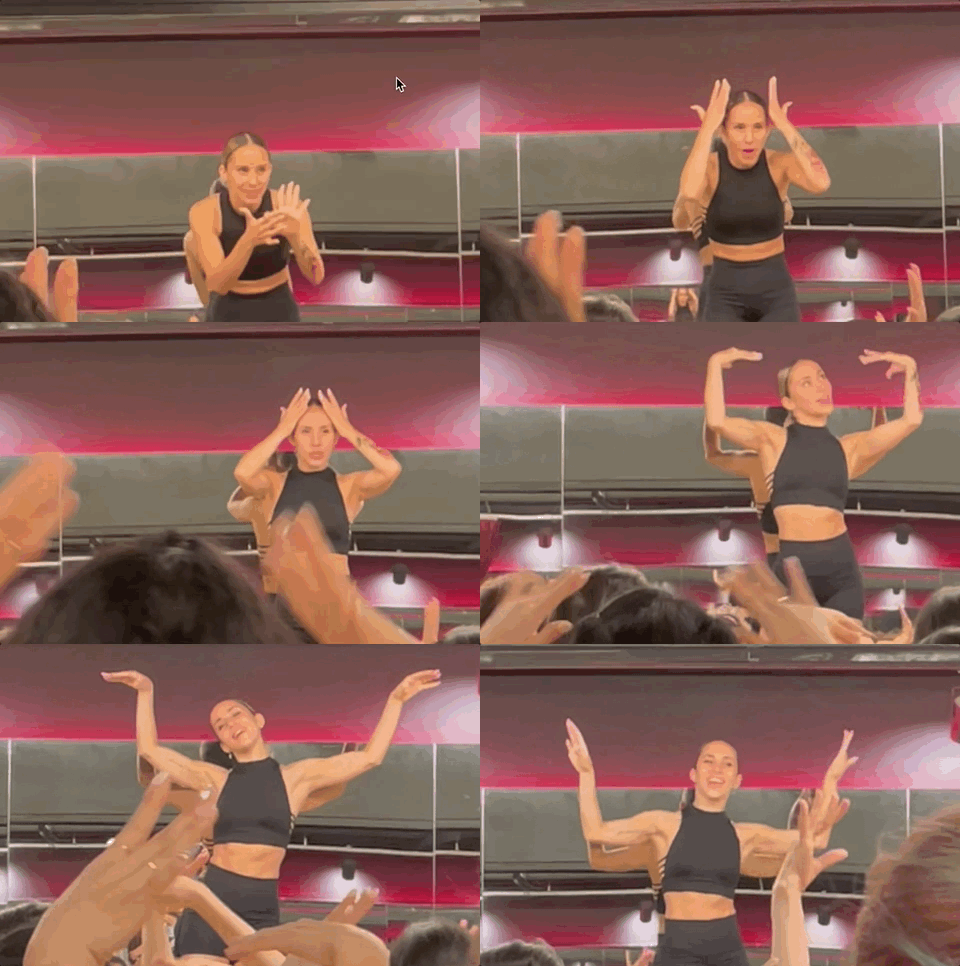
Beauty doesn't come from long arms and legs.
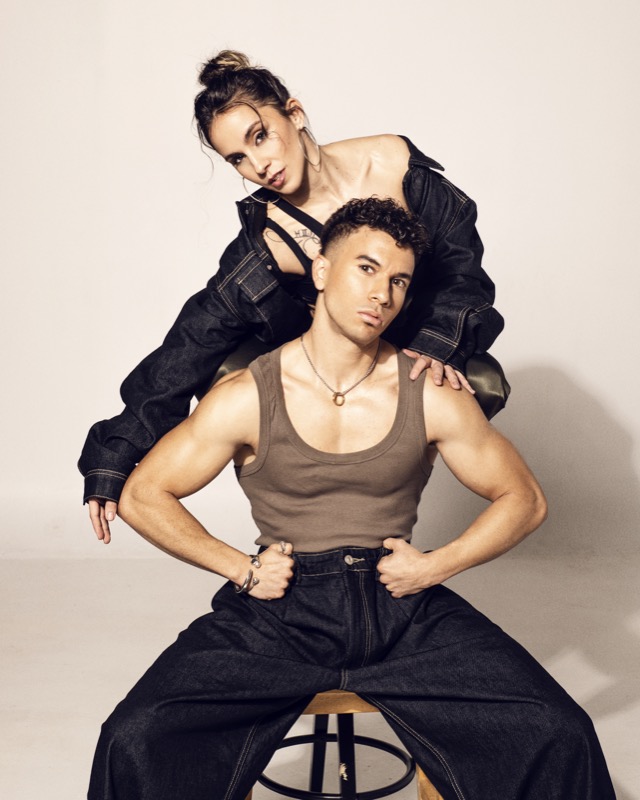
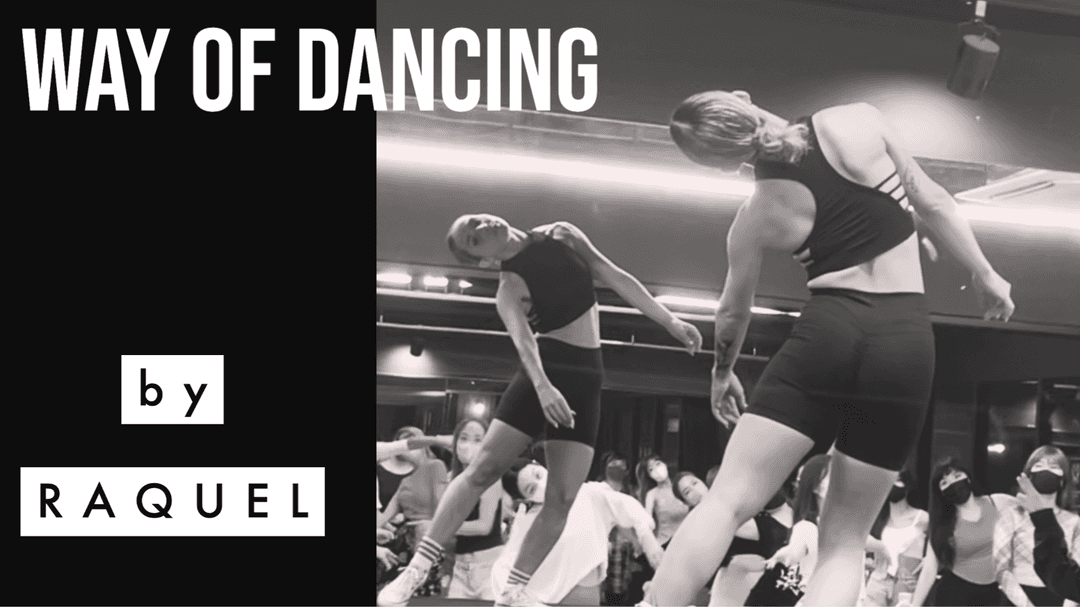
Beauty doesn't come from long arms and legsIt comes from precise posture.Raquel — during the lady styling workshop
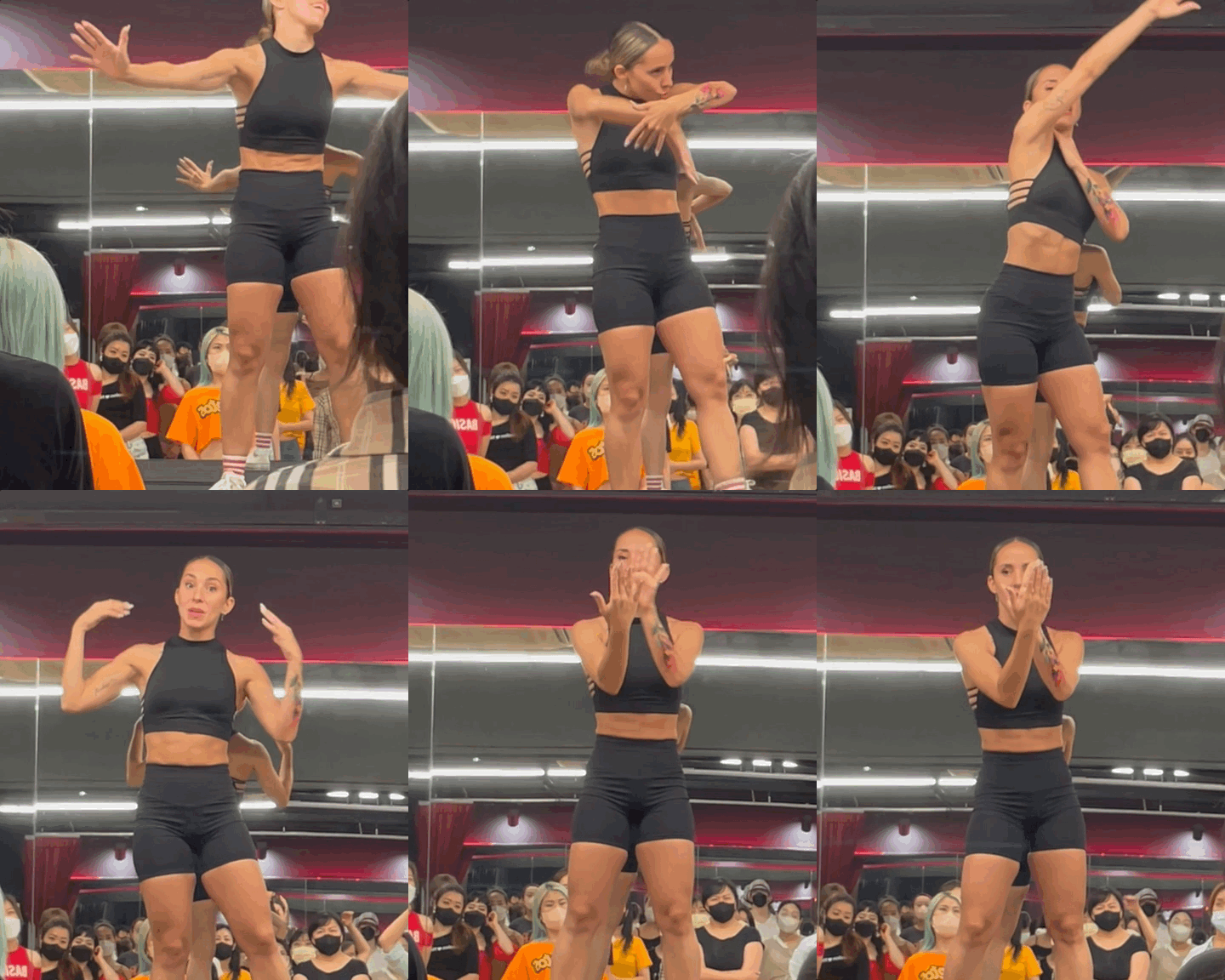
A marionette on strings, sad trees and happy trees, a bus that never comes no matter how long you wait, a rope tied to your center, pushing air out of the way…. A feast of metaphors for those of us who don't know dance and don't know our own bodies. Concepts I sort of knew and sort of didn't, that landed so vividly.
Where does the extraordinary come from?
The True Flavor (眞味) of a Flavor You Already Know
You know how a familiar flavor is the hardest one to resist? These were hours filled with the thrill and joy of hearing, from a master's own mouth, the very things our teachers have drilled into us a thousand times over.
Within the short span of a workshop, Raquel compressed that familiar flavor into a textbook-clear system, expressing it precisely with every single muscle in her body so we could actually savor its true taste (眞味).
You don't need some world-flipping, shockingly new flavor to be moved. Understanding the depth and the real meaning of a flavor you already know is more than enough. The moments of confirming that the path our teachers had led us down was the right path landed as their own proud kind of moving.
We learned well, us! Thank you, ssaems!
Below are fragmentary notes on what Raquel taught us in Korea. It falls hopelessly short of Raquel's own voice, but I hurried to write it all down before it evaporated on me.
There were moments in the workshop where these basic techniques leapt into complex, high-difficulty combinations and applications in partner work. That's probably where real dancing begins. But that's not something I'd dare explain in writing, or that anyone could learn from words.
I organized what follows as a checklist for prepping your dance — like oiling the machine and tightening the screws before you run it. Things to check every day, whether you dance well or badly, whatever dance you do.
So that in the end our socials get a little more beautiful and a little more fun~ May our basics press firmly into the ground, may our backs stay locked in so that even the arms we can't quite use get free. And when Pablo y Raquel come back, may the learning happen at a higher level, on bodies we've tuned up a little better by then♡
Way of Dancing
This is a way of dancing.We're not learning steps or patterns.
Basics — Three Dominican Cadences and the Raquel-Style Sensual Basic
Dominican Bachata — 3 cadences of basic
Smooth Bachata want to reach people as a different way of connection for social dancing, working on basics with cadence, softer leads and quality of movement."Smooth Bachata wants to reach people through connection for social dancing, basics in all kinds of cadences, softer leads, and a whole set of methods for quality of movement."From the Pablo y Raquel interviewPablo y Raquel — the Little Giants of Smooth Bachata, at Their Peak
Cadence
(dictionary sense) The modulation or inflection of movement. The style of a movement as it varies with the tempo of the music.
Even with the same song you can interpret it differently and express it with a different cadence; conversely, when the music changes you can change your cadence to match.
Cadence was the single most repeated word of the whole workshop, used to mean the shift in style by which the same movement gets 'expressed' differently depending on the music or the dancer's intent. Bachata musicality gets expressed through these cadence changes too.
The three Dominican basic cadences and their applications
Dominican basic in three cadences
· Merengue — a bachata basic using the merengue step. Used on sharp, staccato music.
· Swing — a bachata basic using the hip-smile move.
· Figure 8 — a bachata basic using the figure-8 (infinity) move. Starts from a prep (preparation) on the 8-and count.
Applying Cadence, and Musicality
· Applying these three Dominican basic cadences produces all kinds of syncopation combos
· Same music, same footwork — but the flavor of the dance changes depending on which cadence you put in
Raquel-style sensual basic
Like many other teachers who've taught basics in Korea, Raquel too described her basic not as the right answer but as 'her own style'
Upper Body — Side-to-Side Rib Cage Movement
In the sensual basic:
· The arms and the body travel in the same direction
· But what's actually traveling is the rib cage, not the arms
· And the default is for the upper body to travel side to side, not front to back
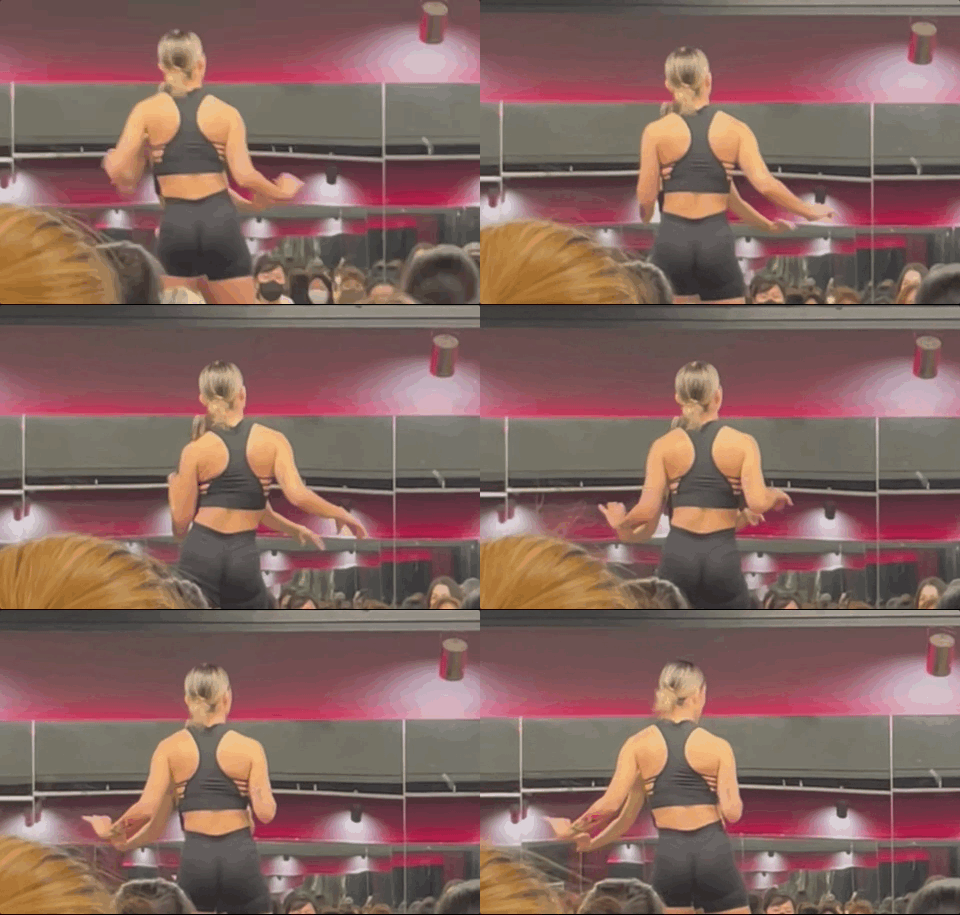
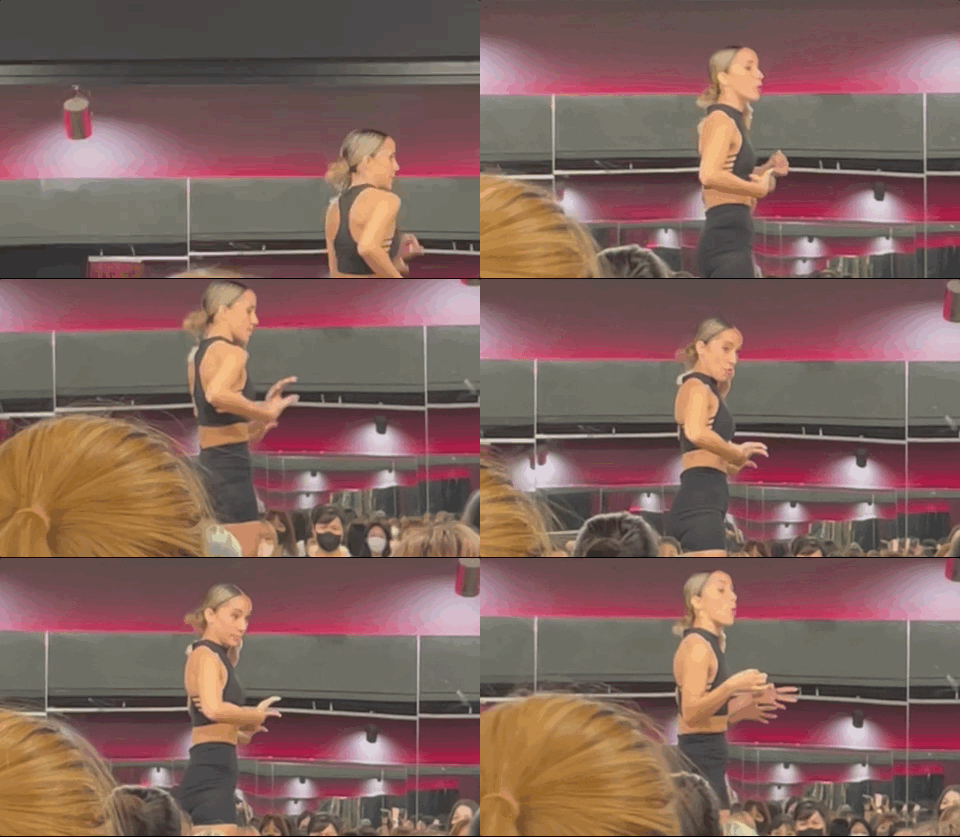
· Both arms drift slightly to the side and twist naturally, but even then you don't think about or move the arms — you focus only on the rib cage moving side to side.
· Upper body counts
counts 1–2 — travel / 3–4 stretch — lengthen
counts 5–6 — travel / 7–8 stretch — lengthen
· Wrists and hands stay relaxed throughout.
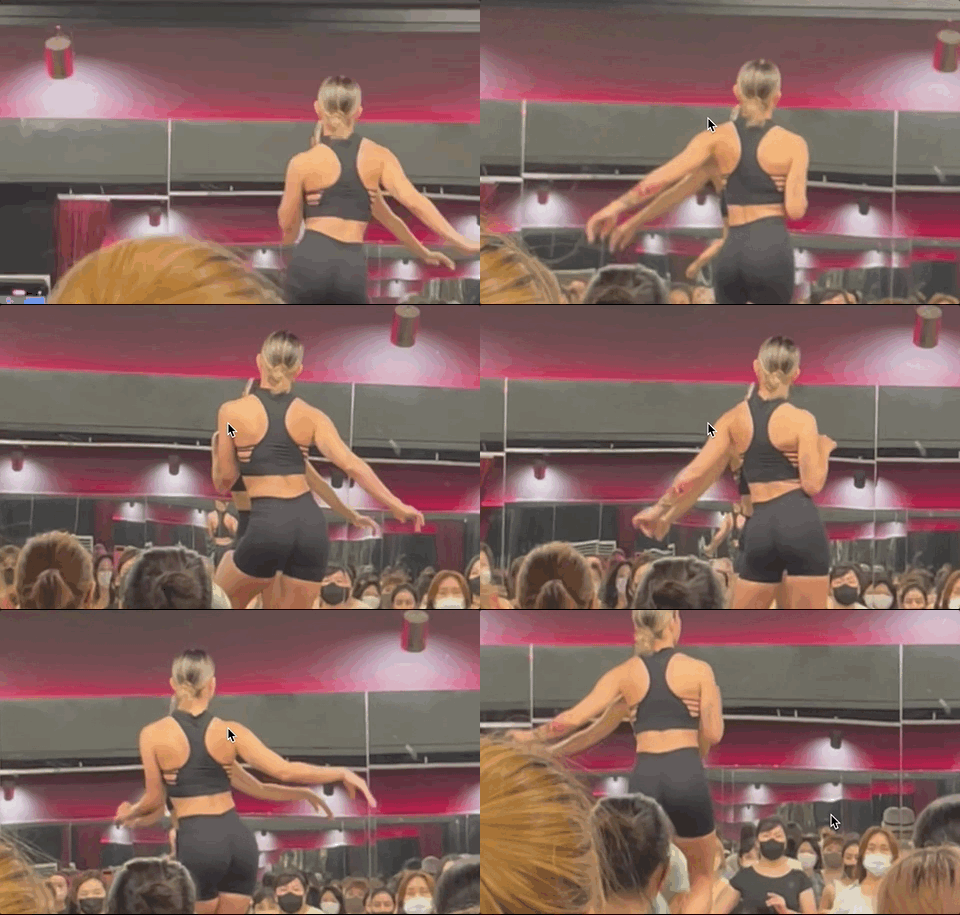
Lower Body — Merengue Cadence (Pressing Into the Floor)
· The Raquel-style sensual basic is built on the merengue basic from Dominican.
· Because it feels more grounded. It's important to clearly feel your feet pressing down into the floor.
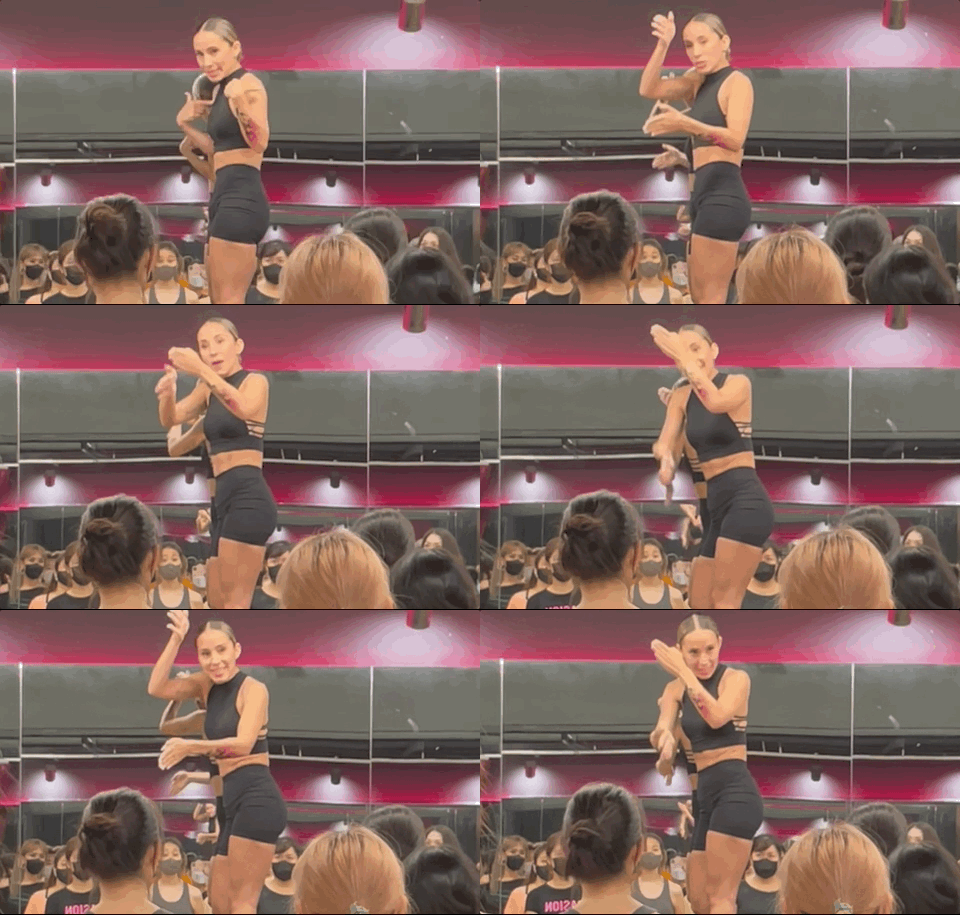
· A basic that (swishes) the hips looks pretty, sure — but the force I'm using is the force pressing into the floor.
· And on counts 4 and 8 of this merengue basic, you draw a round shape as you rotate.
The Sensual Basic's Prep — Waiting for the Bus
"You're waiting for the bus, the time comes and goes and the bus still isn't here… imagine the posture you naturally fall into right then."
· Every move needs a prep (prep: preparation), and the basic starts from a prep too.
· The sensual basic's prep is the 'waiting for the bus' pose
· That is: on the 'eight-and' count, you pop your weight onto the left leg, hip cocked.
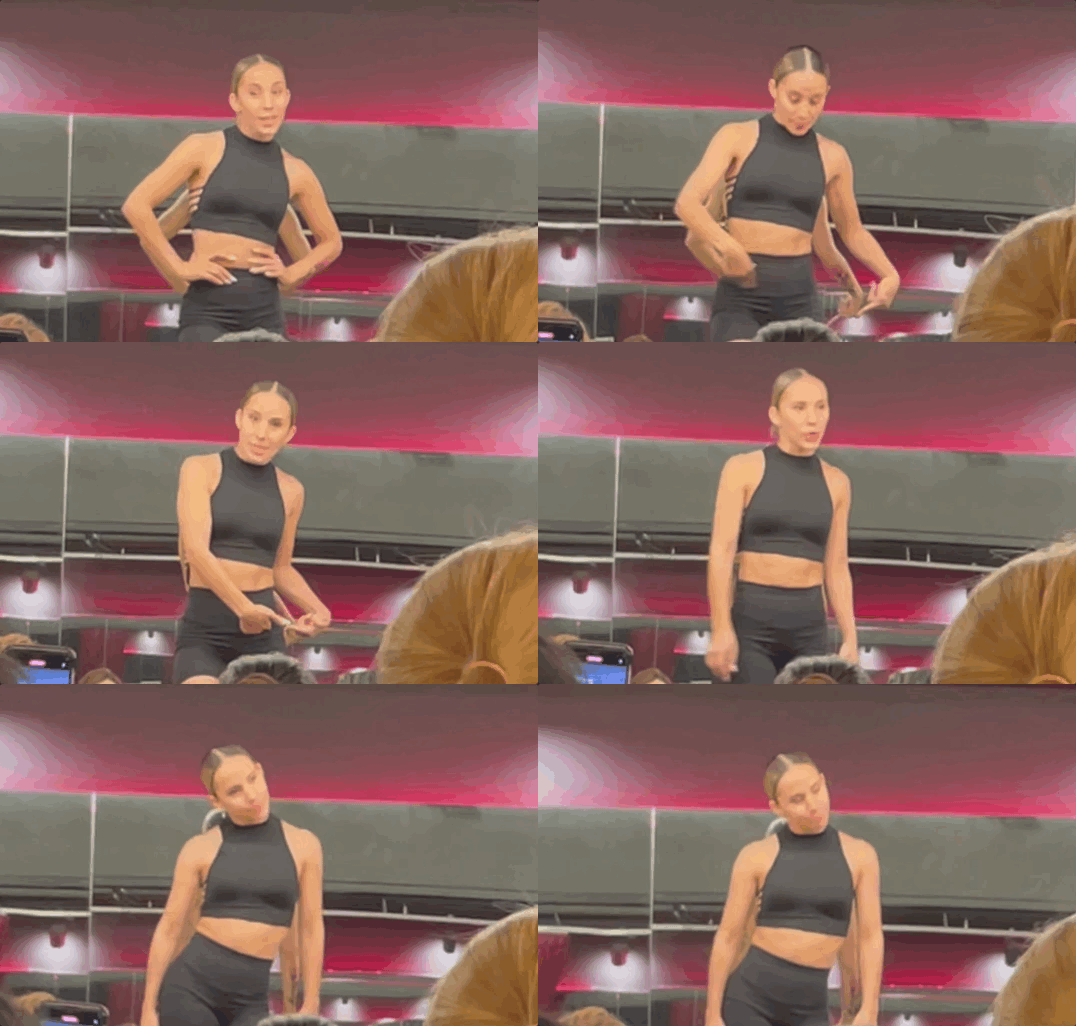
· After the push on the last count 8 comes the prep — you're waiting for the bus, and the leg holding your weight (supporting leg) is the left one.
· Then 1, 2, 3 and push, wait for the bus again, 5, 6, 7, push
· And the steps have to be clean, with no wasted motion
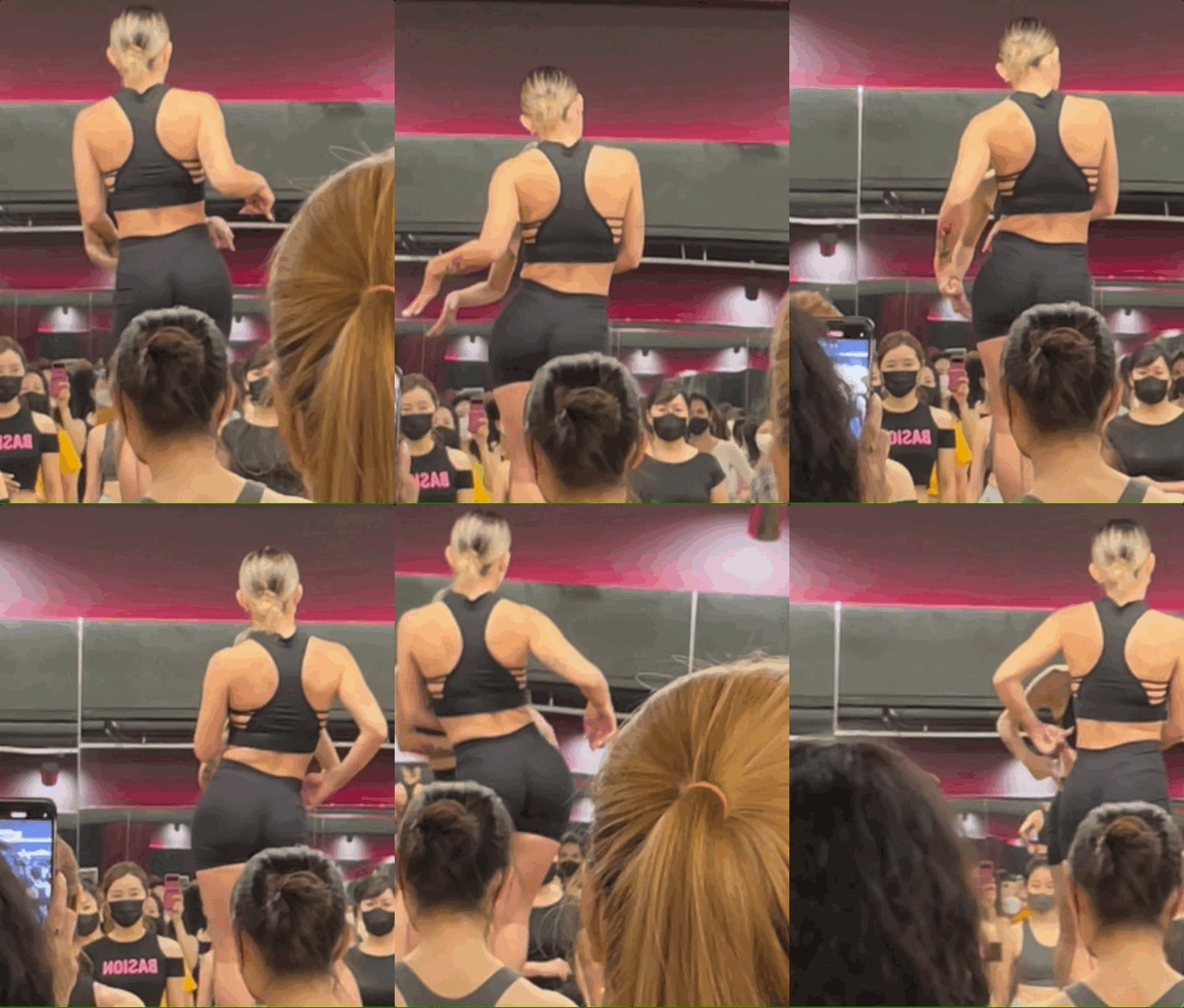
The Relationship Between the Torso and the Arms
· Salsa's upper-body movement uses the shoulders more, but in bachata the rib cage is the main event.
· Use too much shoulder and too little rib cage and the move looks unnatural
· The heart of the bachata basic comes from the connection between torso and hips.
· In traditional bachata, of course, people use the shoulders instead of the torso and focus on the lower body and pelvis rather than the upper body.
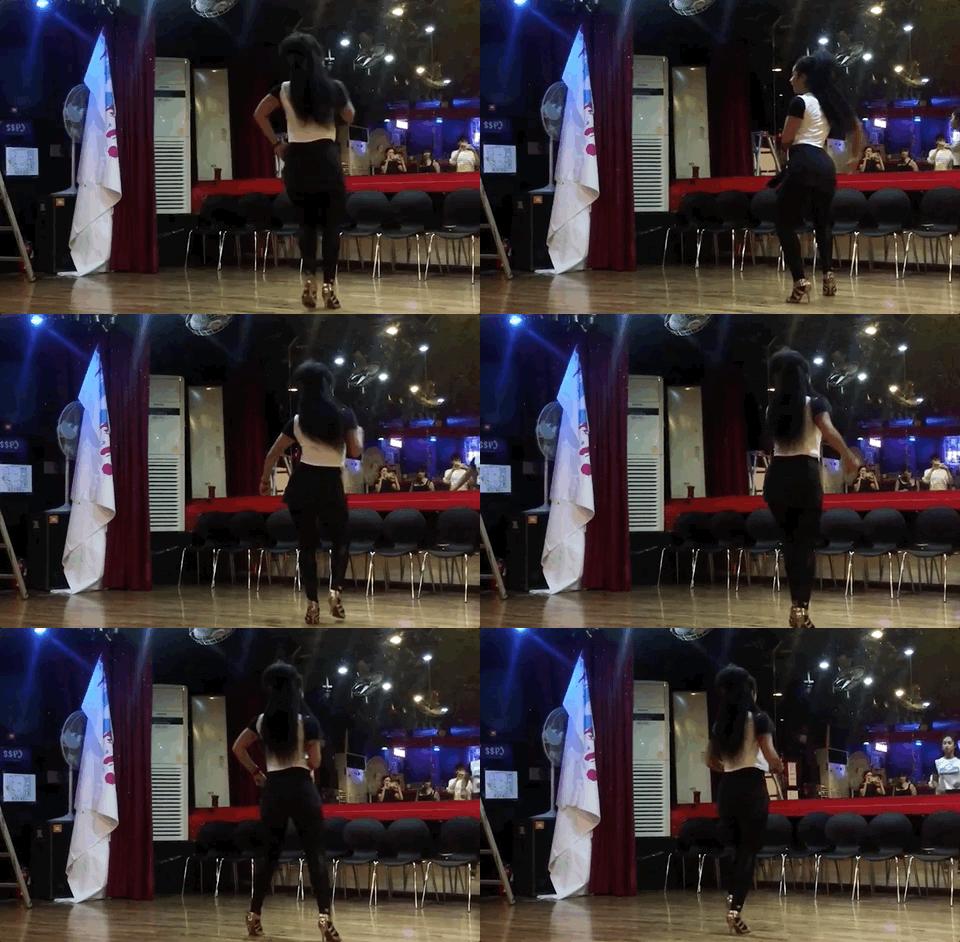
Lady Styling
The foundation of my styling is suspension.With the force of condensing energy and then releasing it, you can do so many things.
How to Use Your Arms (Arm styling)
Throwing the arms — using gravity
Using Gravity
· It comes from surrendering the arm to the weight of gravity and letting it drop
· That's the only way you get natural arm movement
Swing vs Control
· Two ways to use the arms — going with gravity vs. going against gravity.
· Throwing the arm (with gravity) vs. controlling the arm (against gravity)
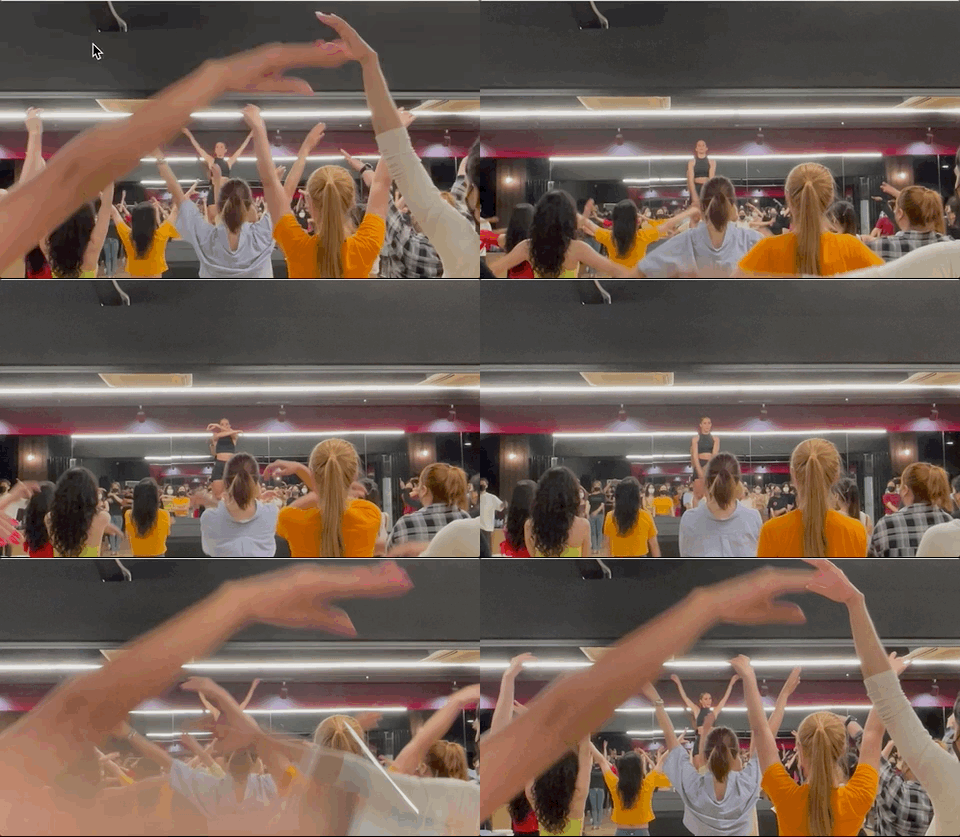
Everyone practicing throwing and controlling with the same arm movement. Fling it, then move it with control, then back again…
What Count Do You Throw the Arm On?
· In styling there's no special count or timing for throwing your arm.
· You learn to throw the arm using gravity, practice it endlessly in all kinds of movements and directions, and then it comes out naturally
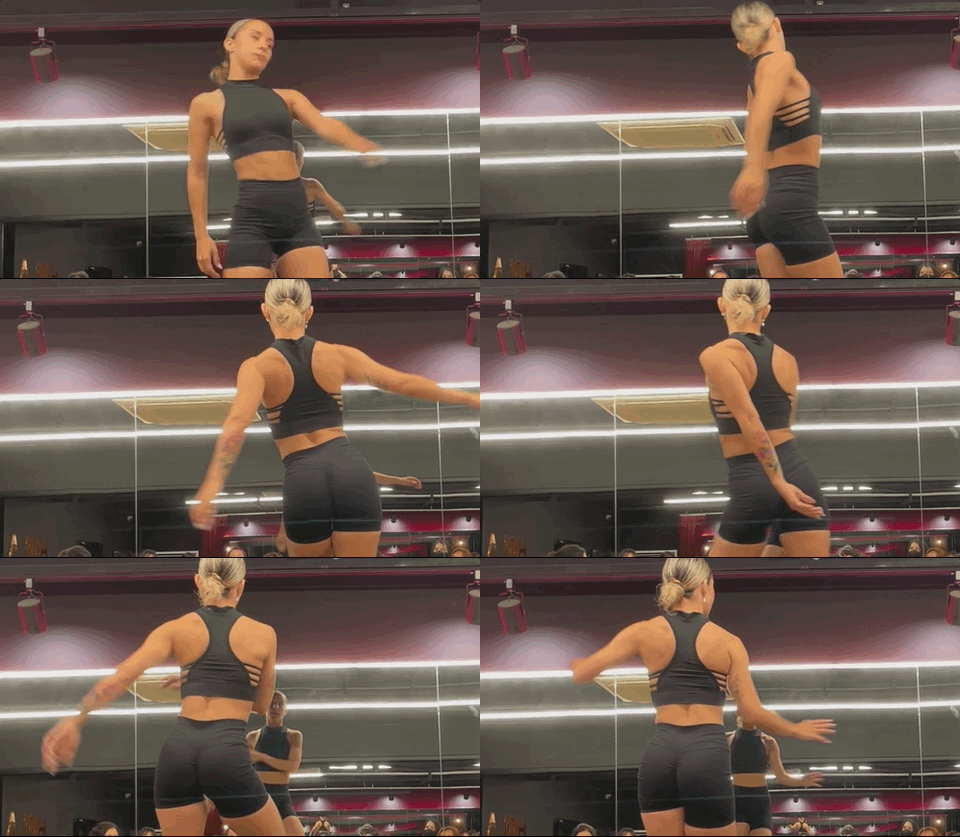
If your fundamentals aren't there, your body will move differently every time depending on your partner's lead.But if you hold the concept of the movement in your head, you don't have to concentrate on what to do on counts 1, 2, 3, 4, and you don't have to think about how to use your arms.Because the arms will follow the body naturally.
Lifting the arms and the frame — breath & engaging the back
Lifting the Arms — Keeping the Shoulders Down
When you lift your arms, think of a marionette with a string attached to your elbow.
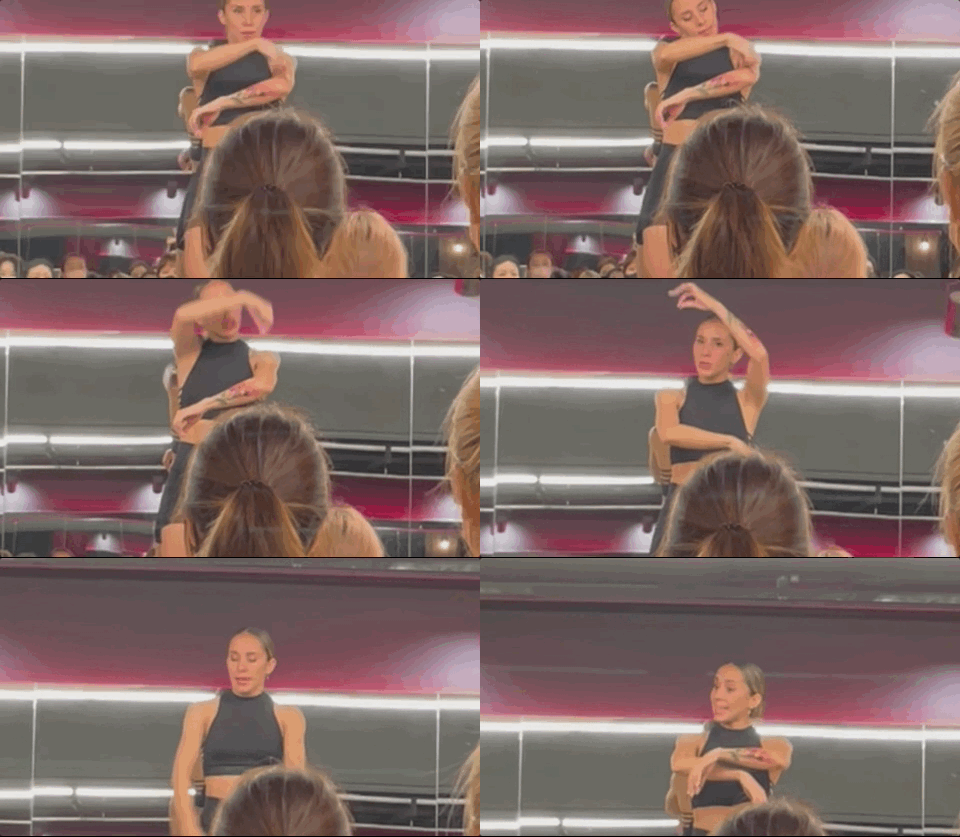
· In arm-lifting moves, you focus on the elbow, not the arm.
· You inhale to lift the upper body, and everything below the elbow stays relaxed
· Then you exhale and throw the arm from the elbow
· And you engage the back muscles between your shoulder blades so the shoulders don't ride up.
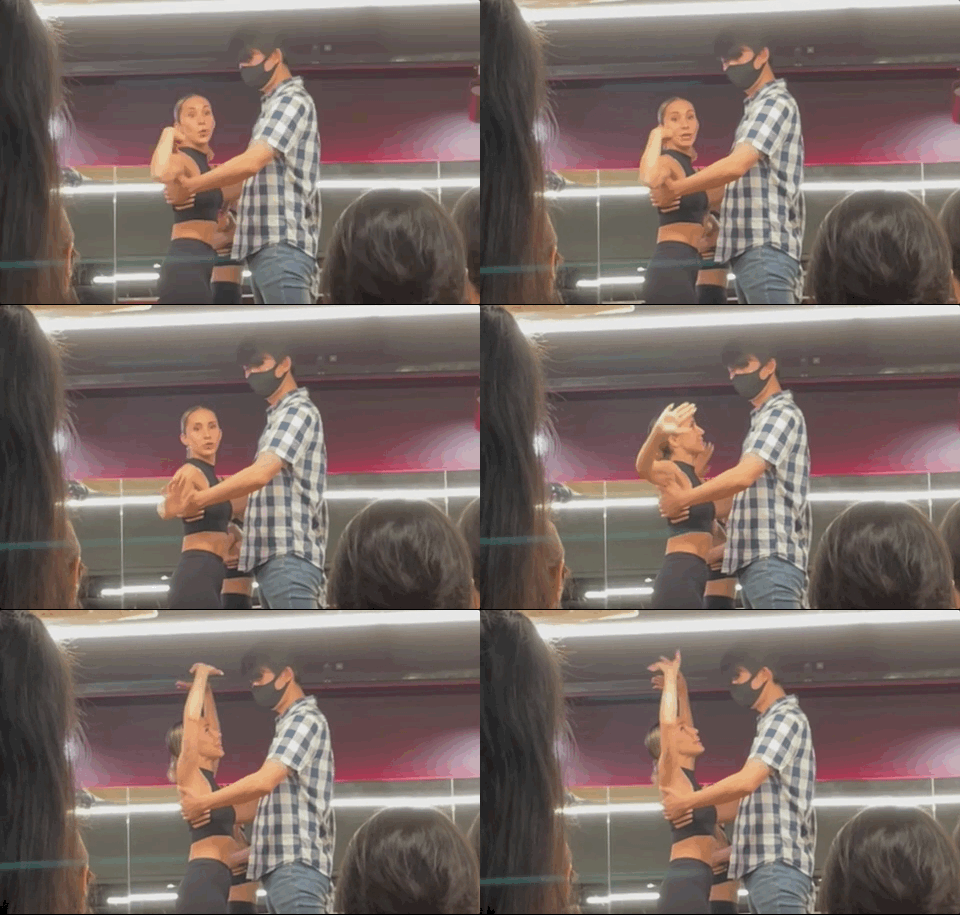
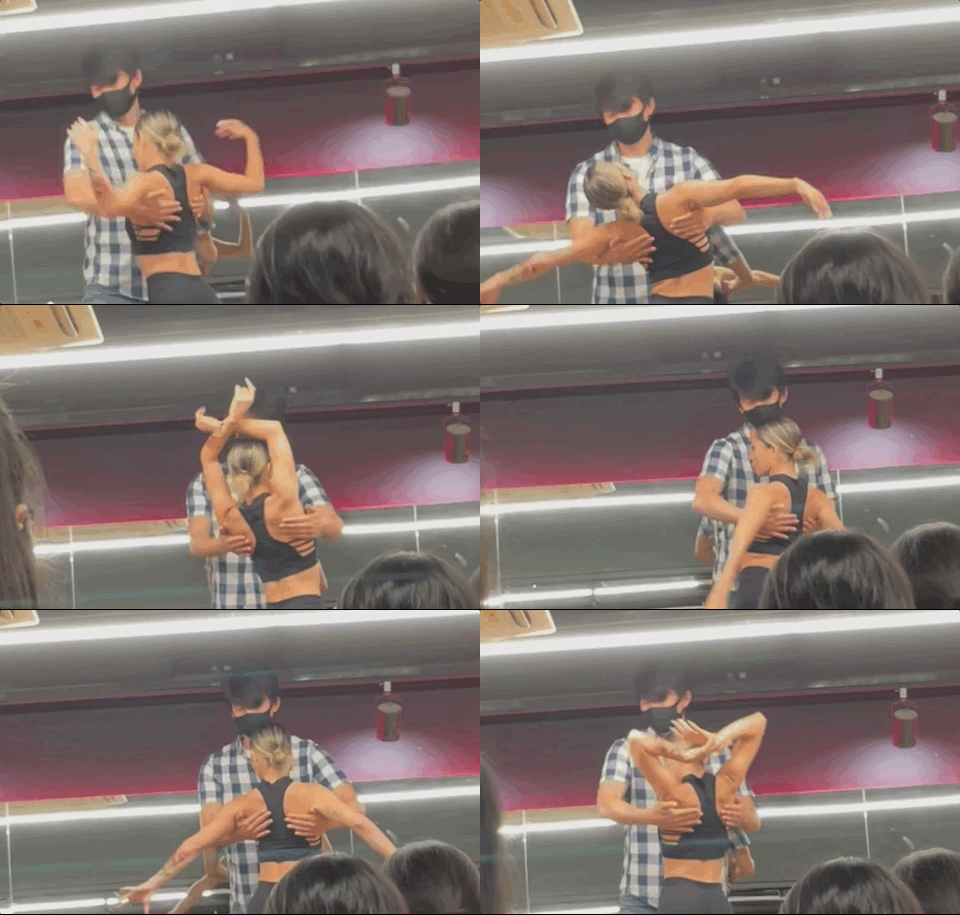
Styling in Partner Work — Free Arms Through Back Connection
· You have to hold this state — back engaged, shoulders down — the entire time
· This is our default posture, i.e. our basic frame.
· You keep this frame and connection through partner work too — even when you lift your arm (to hold), the back stays engaged
· If the back isn't engaged and the shoulders are up, you can't maintain the arm frame
· In partner work the follower has far less freedom — if you're gripping your partner with your arm, the arm is locked and you can never style
· But if you're holding it in your back, the arm is free and you can do anything.
Raising the arms — suspension & drawing a happy tree
The top of the V when your arms are up should be a 'happy tree,' not a 'sad tree.' Shoulders up = sad tree; shoulders down and engaged = happy tree.
· Same goes for when you throw the arms and draw a V at the very top — the shoulders still can't rise; they stay at the same height as when the arms were down
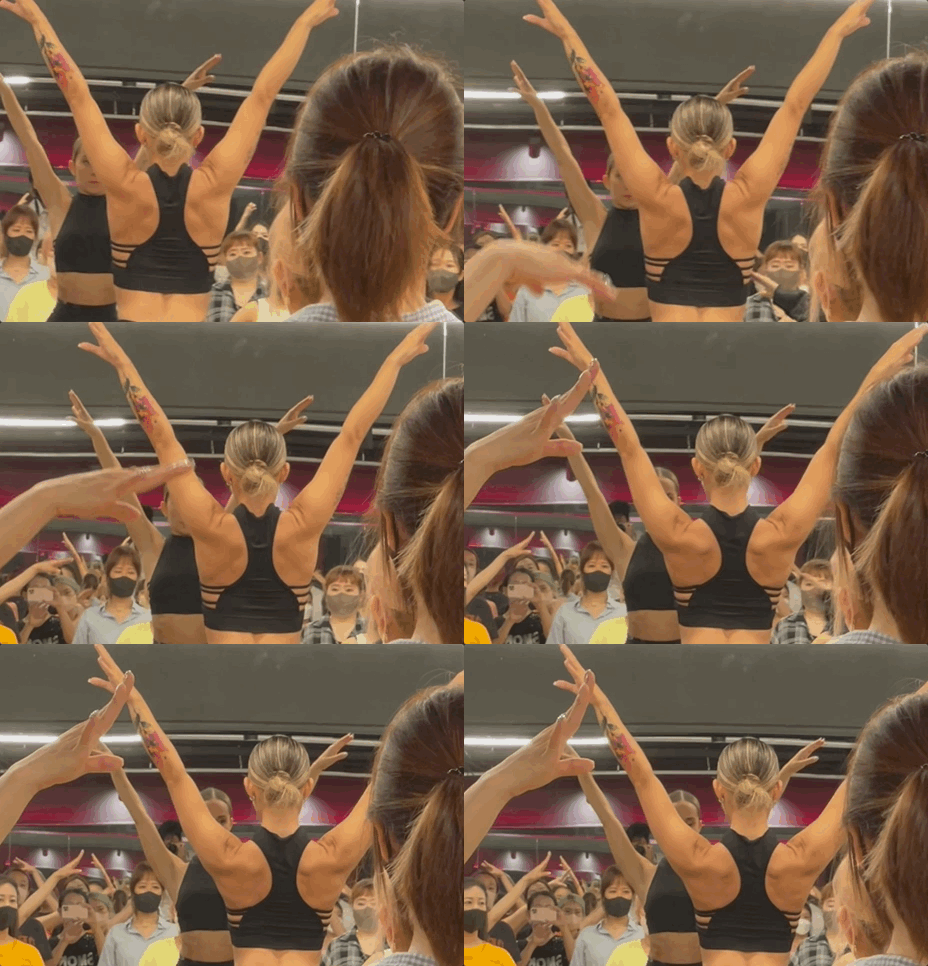
· If the V gets too narrow, it means the back isn't engaged and the shoulders are rising. Our necks are very narrow, after all.
· So make the V a little wider — as much as you can, only within your available range / just enough that the back stays engaged and the shoulders don't rise
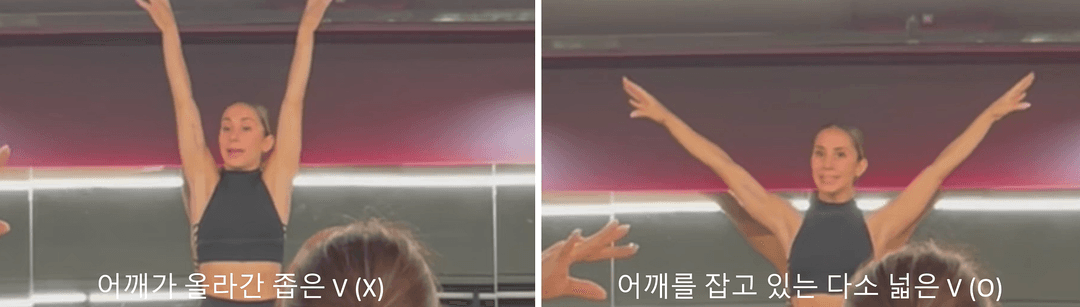
· The moment the V is drawn is the moment the movement changes, and that timing is exactly suspension
(ex) drawing the V, then flipping your palms and bringing the arms back down, and so on
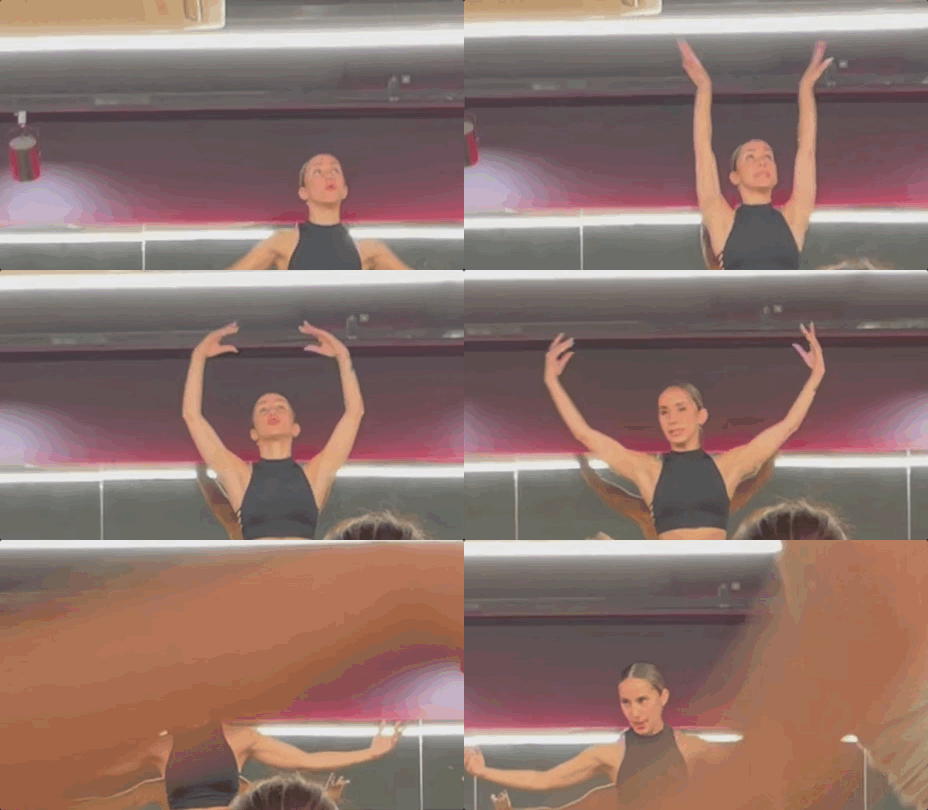
Suspension
· Holding the body for a beat at the peak of a movement and stopping the motion.
· You hold the move for a moment as if briefly defying gravity, then gravity releases it into the next movement.
· A ton of styling is built on this force — condensing energy in the suspension, then releasing it and throwing it. Suspension is the foundation of every movement I do.
Down-Up & Suspension
· Down-up uses gravity; suspension defies gravity and changes the direction of the move
· Use energy and use suspension and you can do all kinds of things.
· It's the same when you're doing the merengue basic, for example: even with one arm held for the partner-work frame, if you press into the floor with your lower body you can channel that energy into a suspension.
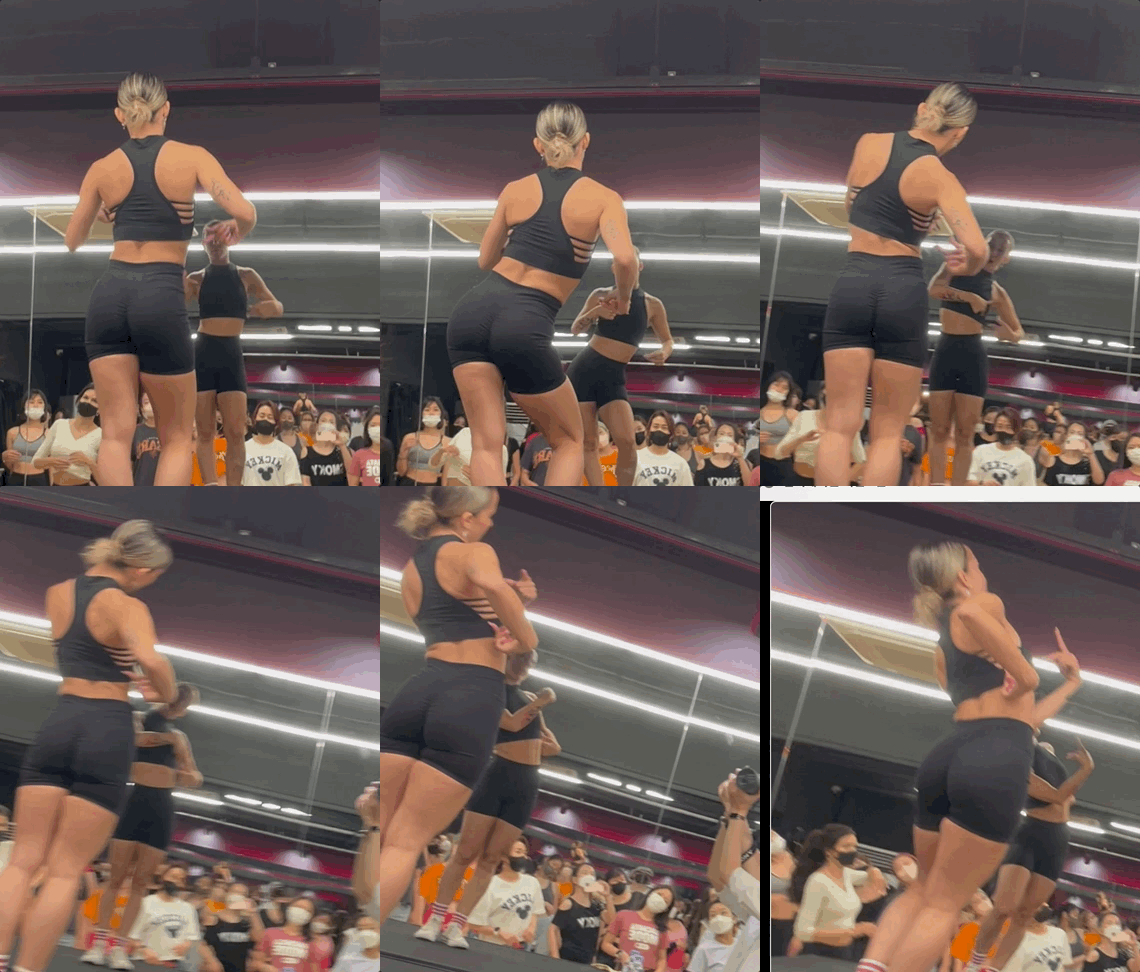
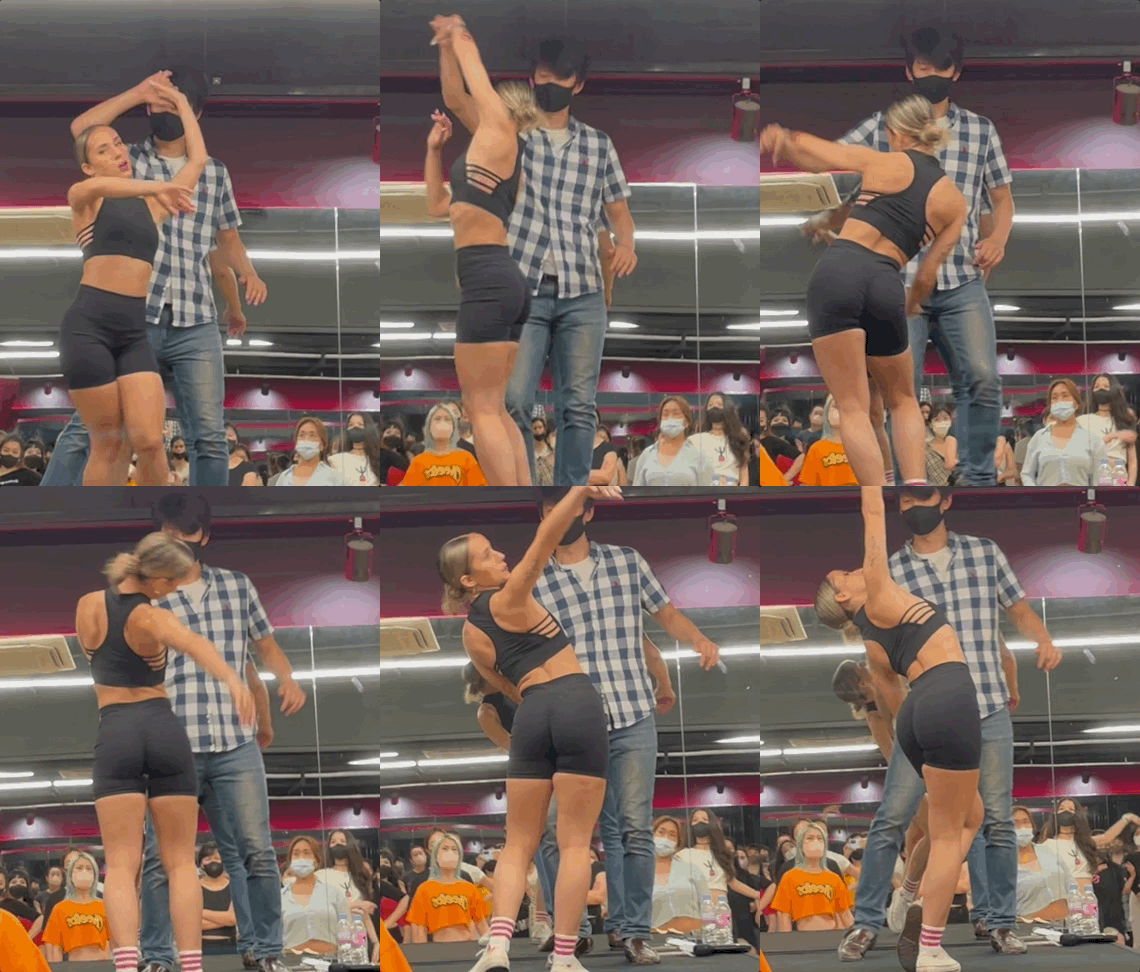
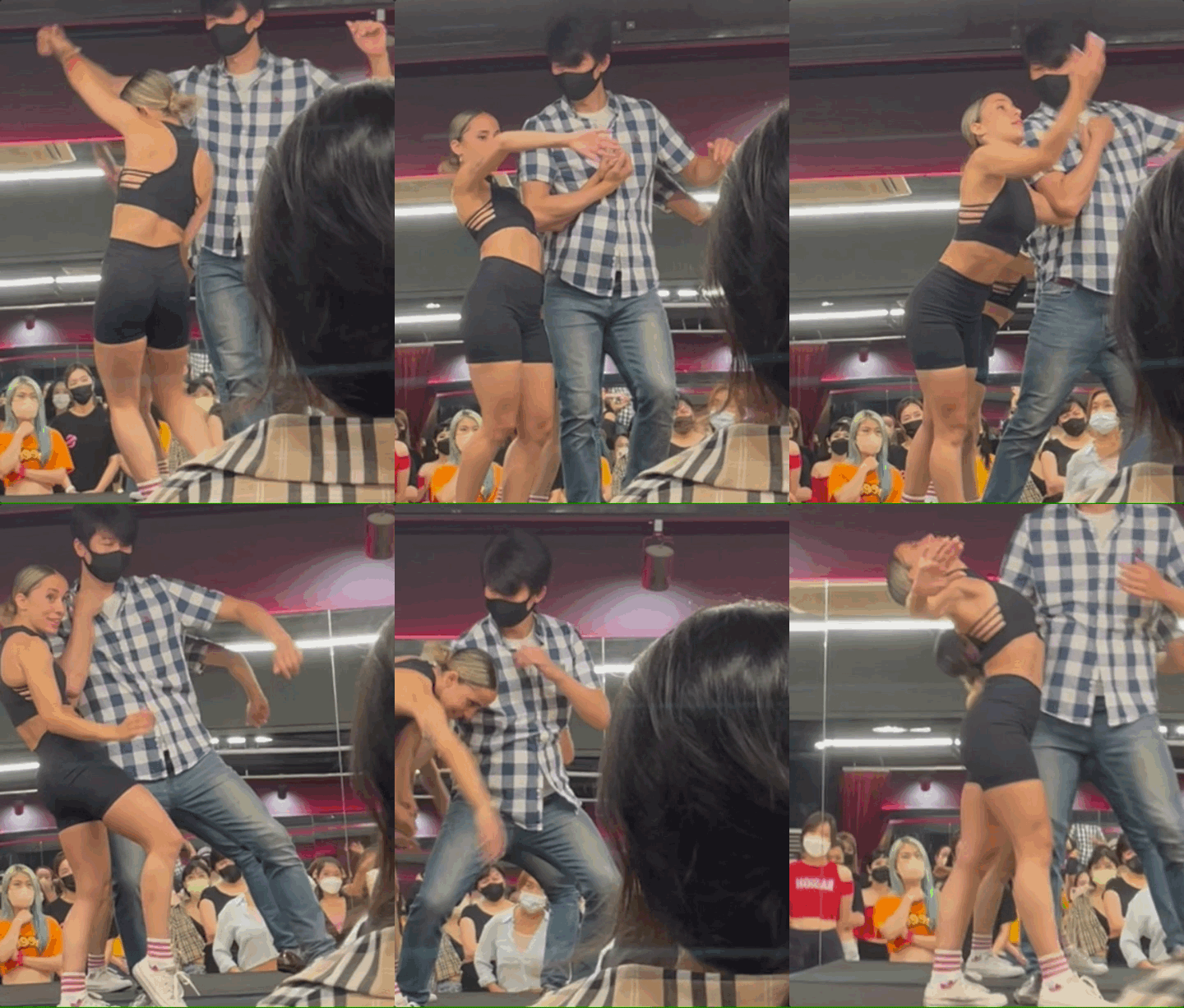
Pushing the arms — a mass of air and the pillow's resistance
Imagine something soft but with texture, like a pillow, and as you push from your back, feel that resistance in the air.
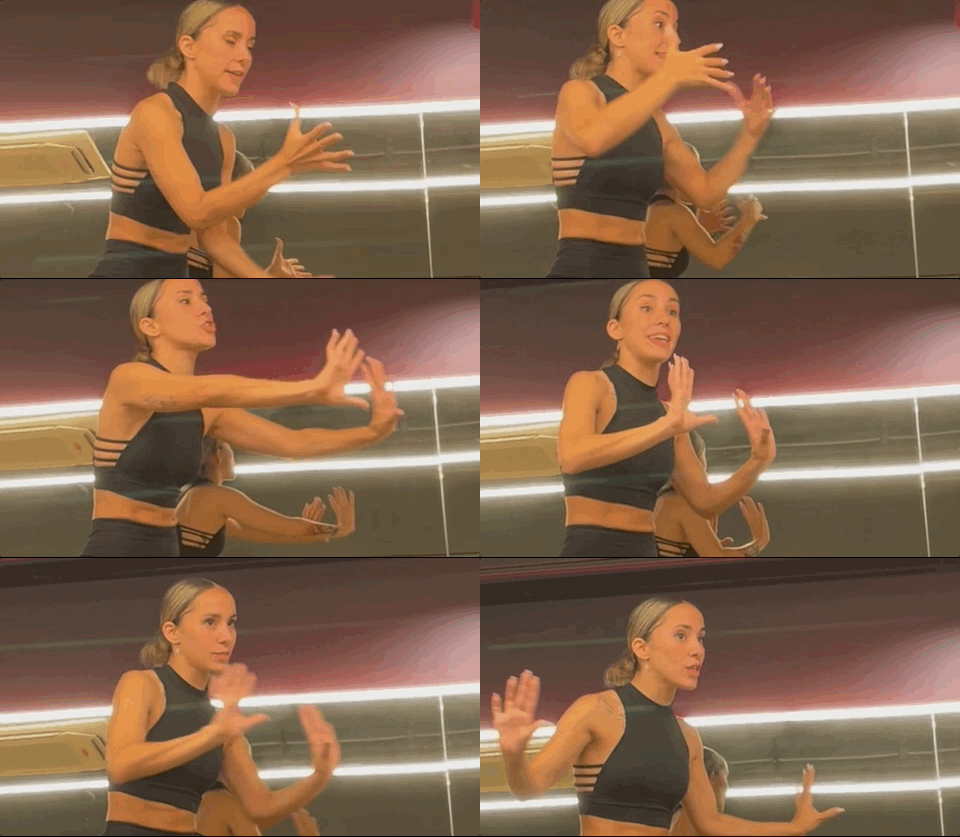
· When you push your arm, push as if there's something there — a mass of air.
· In contemporary dance and ballet, which are my background, you lift your arms for multiple turns. Here too, if you just think of your arm as sitting in empty air you end up flailing it — instead you hold your axis and turn thinking there's something out there in the air.
· Think of the air offering some resistance and sending that energy back toward you, and the movement gets much easier to execute.
Odds and Ends
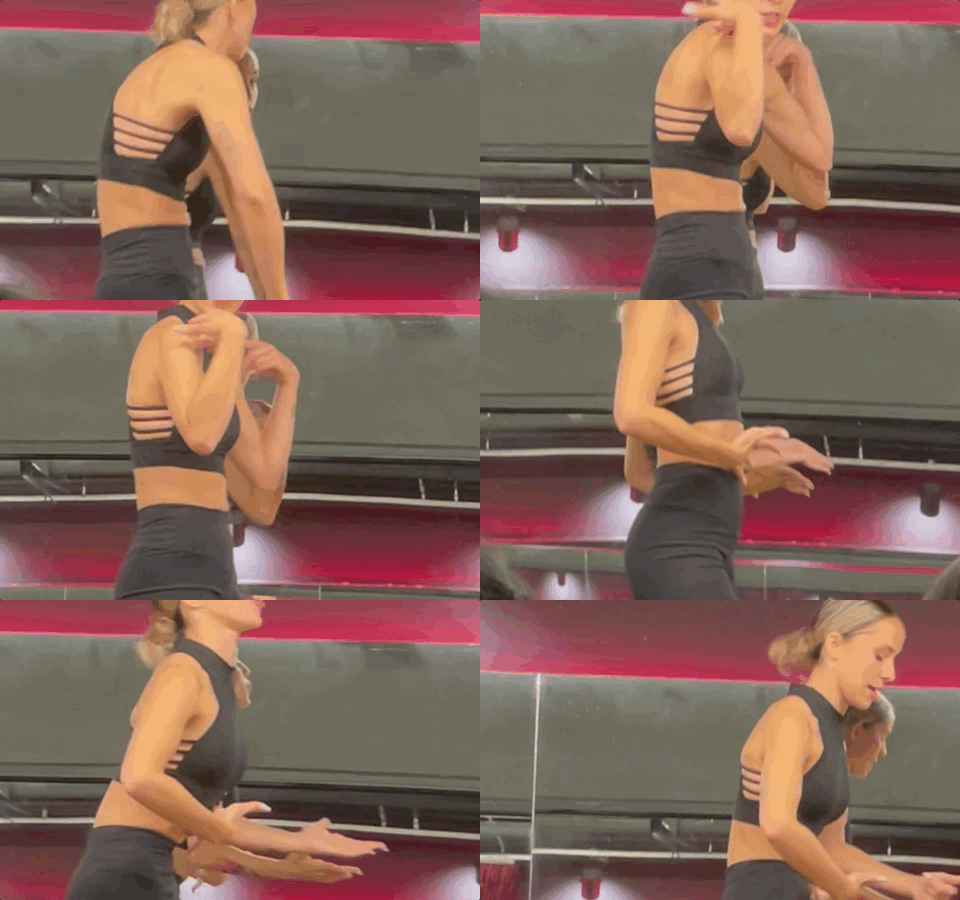
Contraction — like there's a rope hooked to your navel
· The contraction happens as the center gets pushed back
· What gets pushed in a contraction isn't the shoulders (x), it's the body's center (o)
· Do it as if a rope runs from your navel through to your back and someone is pulling on it.
Using the head
The key to using your head is: "you don't use your head."
· The head just follows the torso. Always.
· Apply this to the side roll and you get: you change direction first, then the torso travels — the rotation and the torso don't move at the same time.
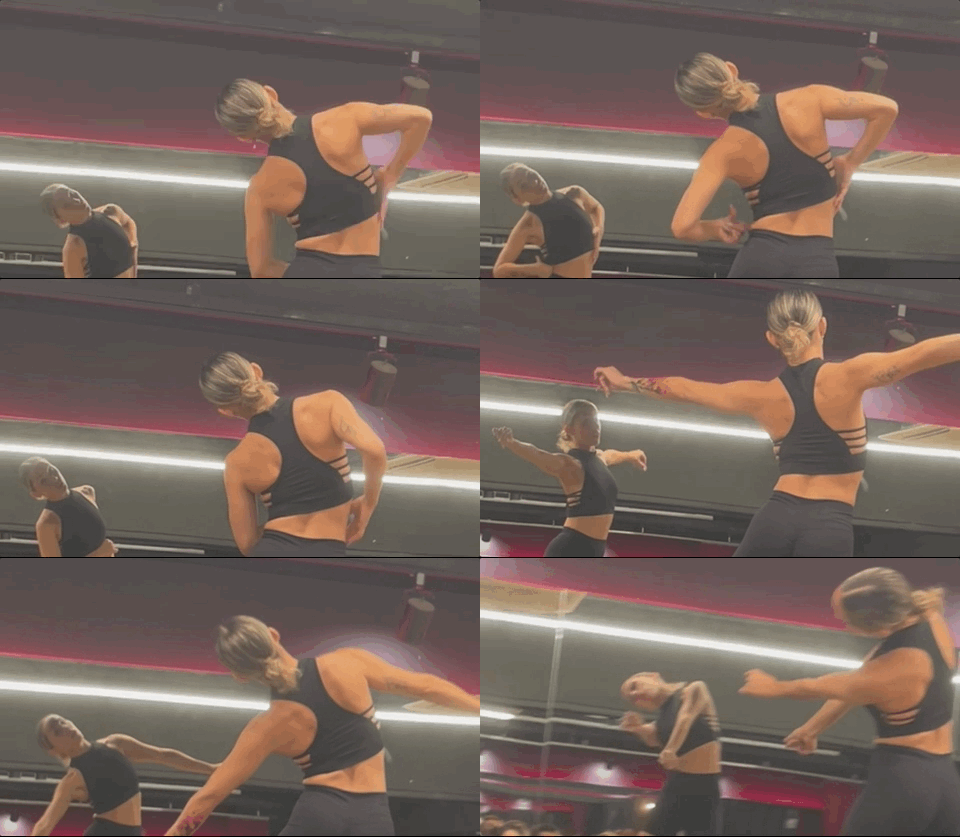
· And obviously the head doesn't travel either.
· And when leading, the guy also has to shift the direction first, then travel.
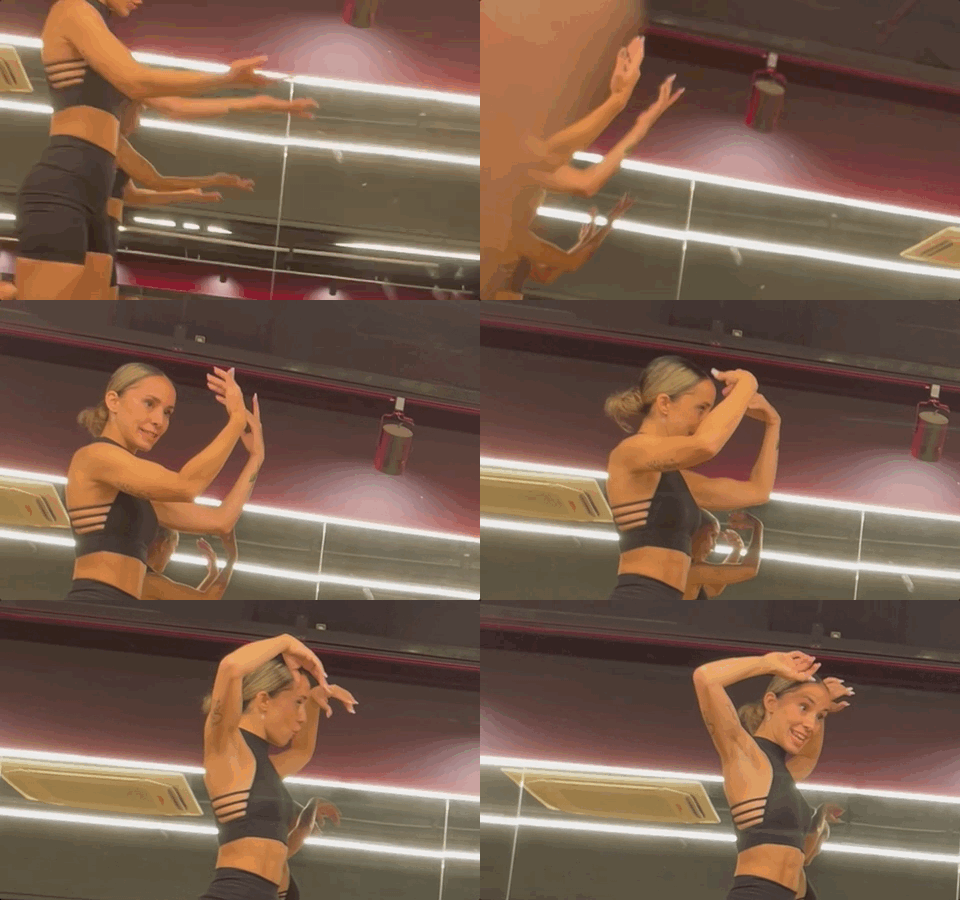
Using the hands (palms)
· When you use your hands, always focus on the palm, not the fingertips.
· Not a headache-grip with the fingers clawing at your head — a palm touching your head.
· Same when you touch your head, sweep your hands up and down your body, or run them through your hair
Expressing specific movements — actually feel it
· Take the move where you wrap your arms around yourself — you have to really hold yourself, not just pretend to
· Same for styling where you sweep your hands down your own body
· Just putting your hand on your body and actually feeling yourself are completely different things
· You have to really feel your body, feel all that energy, and then spread that energy back out
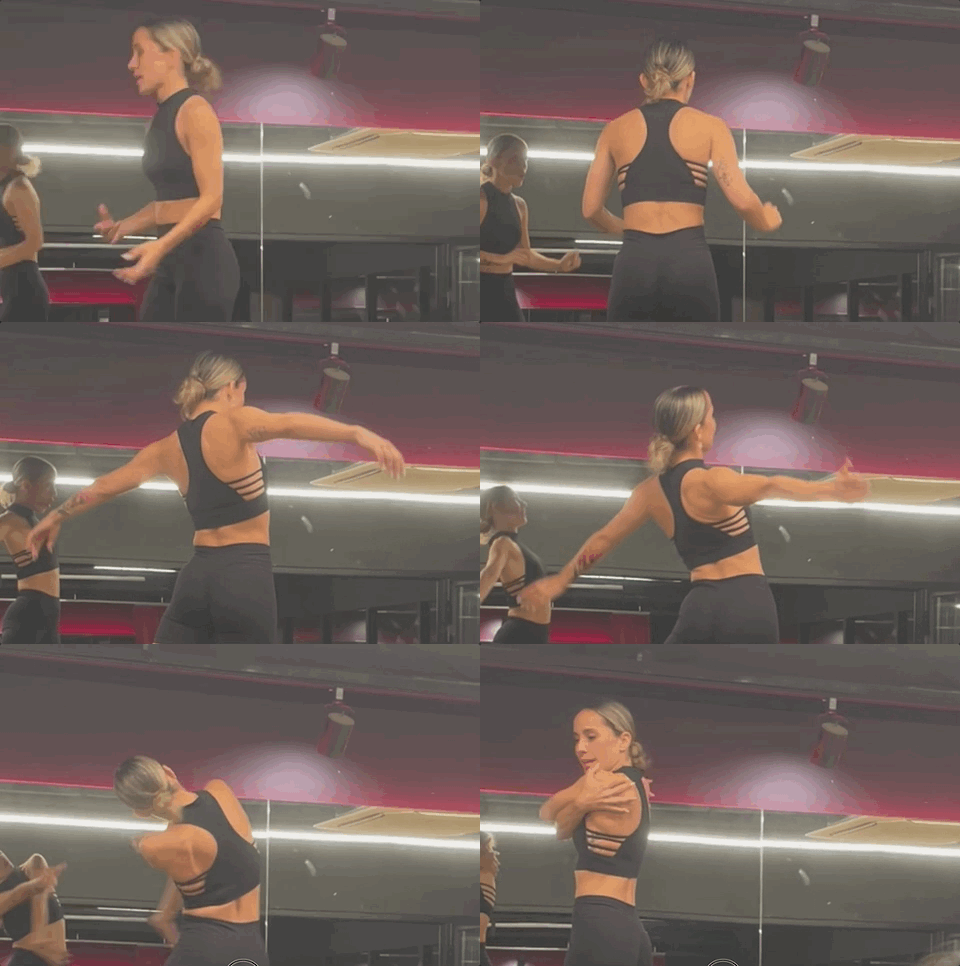
Timing your styling in partner work
· Styling for a performance and styling in partner work are very different.
· I think both matter, so I try to teach a mix of the two — but styling for social dancing comes first.
· I don't recommend styling with a leader whose frame isn't good
· Because while you're dancing, keeping the connection is the top priority.
· But if you can feel the contact and the frame in your back, then you style — at that point the connection with the guy is already there, so you can use your arms freely.
· That's how you read who you're dancing with and find the timing for your styling.
· Of course, receiving the lead matters most. Receiving the lead is always priority number one, and styling comes after.
After all that brilliant teaching and dancing, Raquel burst into tears. Pro dancer or not — imagine how heavy the awkwardness of the situation must have been, plus the pressure of having to carry the whole thing alone, without Pablo.
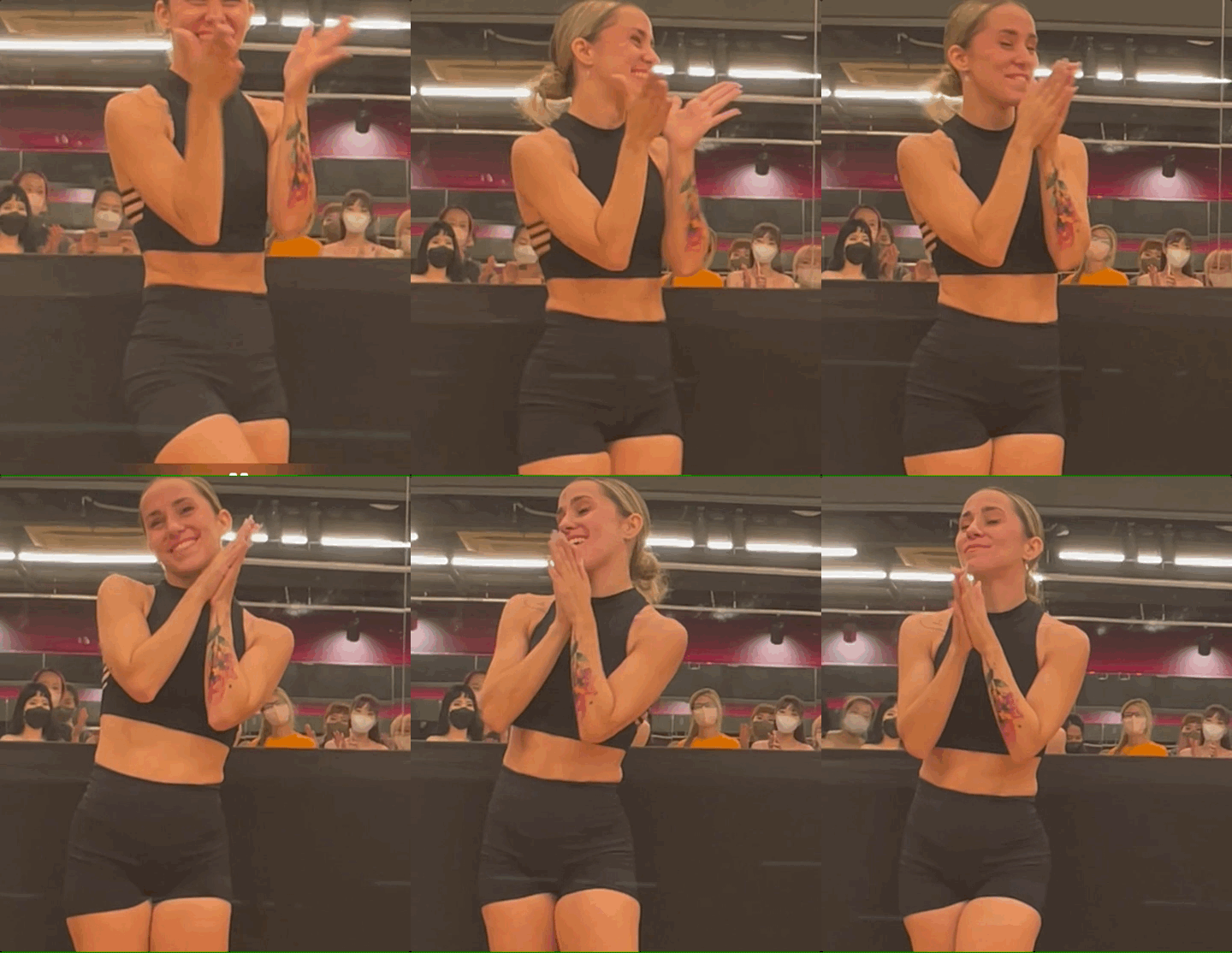
But Raquel went way past "good job" and moved every single one of us. In the end, thanks to Pablo (?!), we got to discover Raquel's true worth and have her all to ourselves — a stroke of luck we probably won't get again. And on top of that: a beautiful soul that seems to have gathered up all the loveliness in the world, and a wonderful character to match. Raquel the enchantress…
Grateful for discovering Raquel and for all this wonderful learning — and even if the things I can't do I'll probably go on not doing (certain), I'm definitely going to make sure I can do the things I can do!!! (judging by the multiple exclamation marks, not certain)
Nari-ssaem's teacher, and therefore my teacher's teacher.
Raquel — my teacher's teacher — waiting for the day we meet again —
 4
4