 My Honey Jar

Sara Panero's 'Reverse' Technique - Basics Alone Get Boring
Reverse a move you already know, and a familiar taste turns new. Infinite variations on the basic hip moves.

Don't just do the basic.It gets boring.Sara Panero - from her lady styling workshop
Seoul Bachata Festival, Sara Panero's lady styling workshop. In ninety minutes, Sara taught almost no new moves. Instead she took the moves we were already doing, one by one, and flipped them backwards right in front of us.
The ocho, reversed. The hip roll, reversed. The turn prep, the other way around.
Same steps, and yet a completely different dance came out.
Reverse
Usually, 95% of turns we prepare out and turn in.This is the opposite. We prepare in.Video 7:52

The keyword of this workshop was reverse. The reverse ocho that wraps the other way, the hip roll that rotates in the opposite direction, the turn prep that winds in instead of out. We didn't learn new moves - we only changed the direction of moves already in our bodies, and the mirror showed a picture I'd never seen. (And true to a first-time picture, my body played innocent too. I know this move... why isn't it working...)


Why it doesn't work is actually obvious. To flip a move backwards, you have to truly know the original. In the normal direction, habit dances for you - in reverse, there is no habit. If you don't know which foot your weight is on right now, where your hip starts and where it's going, you can't take a single step. Reverse wasn't failing because reverse is hard. It was failing because my original was blurry.
Aito points at the same spot.
All the applications of hip moves come from the basic isolations. That part really matters.Aito - Musicality class 10:28
Three Axes
When you create movement, think about the direction of the hip first.Mix in level and body direction, and it looks completely different.Video 1:36

Sara's variation formula comes down to exactly three things. The direction of the hip (front, side, back, center), the level, and the direction the body faces. Swap just one of these into the same basic and the combinations keep multiplying. Three times three times three is already twenty-seven. (Of course, the math and the body are separate problems - I confirmed that in the mirror that day.)
There are so many options.You can find your own, too.
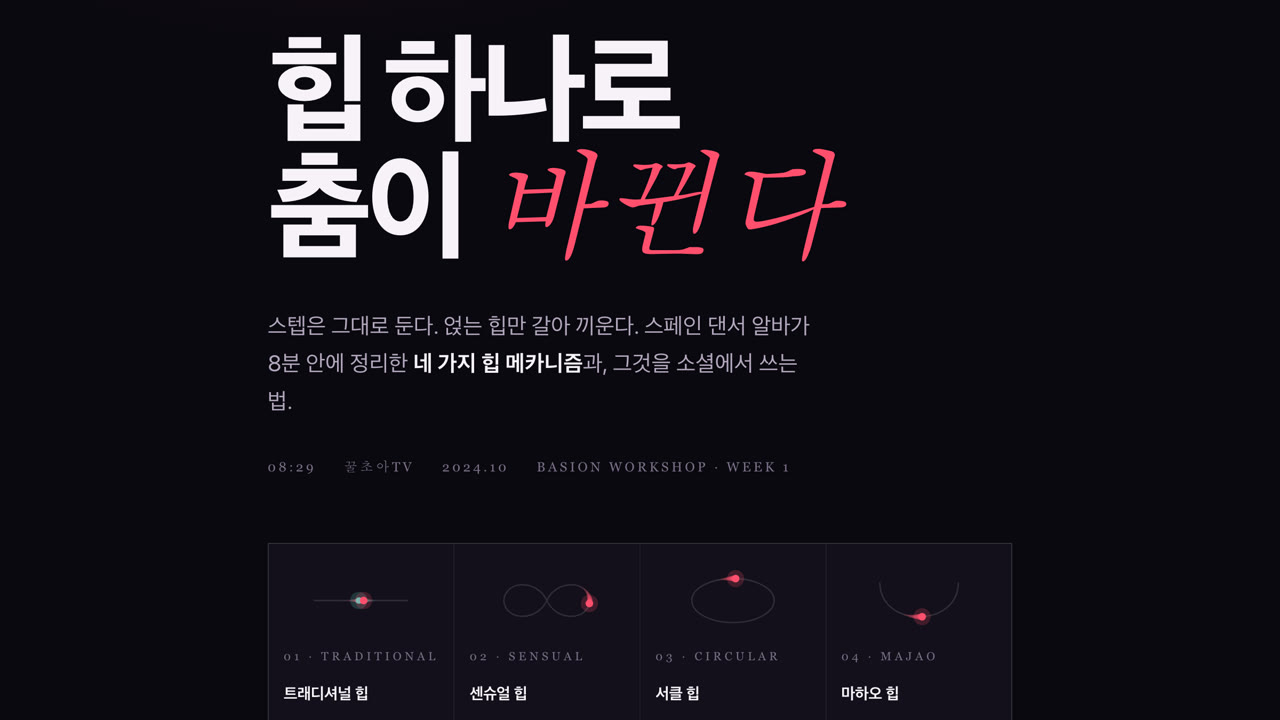
In Bachata Hip Mechanism 4, Alba sorted the hip into four trajectories - traditional, sensual, circular, mahao - while Sara unpacks the same hip starting from direction. If Alba showed the kinds of lines a hip can draw, Sara shows that you can redraw those lines in any direction. Read the two pieces together and the full picture of hip movement gets pretty clear.
Knowing Your Body First (Body Awareness)
Variation has one prerequisite: knowing what your body is doing right now. This is why Sara's explanations landed so well in this workshop - she doesn't describe moves by their shape, she describes them by sensation.
Literally, feel the hip sitting over the ankle. That's what I feel.You keep resisting the chest that wants to follow. You're fighting with your chest.Use your breath and it gets easier. Inhale, exhale.The shoulder is one joint, and the chest is a different part of the body. Don't mix them.I use the floor a little, and stopping gets comfortable.

Hip over ankle, a chest that wants to follow, breath, separating shoulder from chest, the floor. All of it can be checked without a mirror. So Sara's class wasn't a class for memorizing moves - it was practice in knowing where your body is in real time. Body awareness, as we call it now.
What Sara said three years ago, when she came with Marco, sits in the same place.
I can control it because I know where I hold, how far I can go, where my flexibility ends. If you copy this without knowing that, you get hurt.Sara Panero, 2023 - Video 5:52
Luis and Andrea point at the same spot.
Really feel every point of the movement, use every muscle, feel the tension in each part. Always go to your limit and come back.Luis y Andrea - Body lesson 7:10
Before flipping anything backwards: in the normal direction, which foot is my weight on? That's why reverse is, in itself, body awareness practice.
Sara's Philosophy
While editing the main video, I actually cut the philosophy out into its own piece. The skeleton of the workshop is here.
You have to challenge yourself every time. If you stay where it's comfortable, you don't grow.You have to push more. But you need to know what level you're at right now. Being here and trying to get there in one day? That doesn't work. You're left with frustration, and it's not worth it.So you should know: I'm here, the goal is there. When one thing gets comfortable, find the next. That's how you grow as a dancer.
Change it when it bores you, but change one stair at a time. Exactly the same structure as the variation story. And on the order of learning:
If you watch me move my arms, body, and feet and it feels like too much information, forget everything. The most important thing is always bottom to top.Weight transfer first. Then footwork and hips. Then chest, then arms. The head comes last - it's the hardest.If you've been dancing about six months, this much is enough. Don't push yourself too hard. If you start stressing on the second eight-count, your head will explode.
The body goes bottom-up, and skill goes one stair at a time. Sara's class teaches dazzling variations while guarding, to the very end, the order in which you reach them.
I cut this passage into a one-minute short. Sara's hands and face say half of what the words can't.

Sara's Way of Dancing
I dance many styles. Each one gives you different skills.In the end, becoming a better dancer isn't about bachata or salsa.It's about how well you control your body.
Variation is a practice method before it is decoration. Doing the same move in a different direction, at a different height, with a different texture is itself training your body to work in finer pieces. That's why Sara said she keeps giving challenges to herself and to her students. When it gets boring, change it - and changing it is how you grow.
There's a line Raquel left in Korea four years ago. I wrote it down in What I Learned from Raquel.
This is a way of dancing.You're not learning steps or patterns.
Sara's workshop was the Sara version of that sentence. Not the steps, but how to handle the steps. Sergio saying "smaller is better - small but precise," Sara saying on this same stage three years ago that "hip moves start from pushing the floor" - it all meets here. The flash comes from variation, and variation only comes from a precise original.
And so Sara brought the roots of bachata with her - the hip and the basic, the fundamentals and everything they can become.
Notes
Below are the fundamentals Sara kept returning to during the workshop. A summary that falls far short of her voice, but I wrote it down quickly before it all flew away. Like Raquel's class - like oiling the machine and tightening the screws before running it - a checklist to go over daily, whatever dance you dance.
· When transferring weight, focus on the floor. Hip moves start from pushing the floor
· The upper body is 'stable', not 'fixed'. When the hip moves, resist following it
· Keep the knees soft. Lifting the ankle is not technique
· The hip feels like it rides on top of the heel
· Contraction is head forward, belly in. Not the shoulders
· Always keep space between ear and shoulder
· Arms only make the movement look bigger. Arms go up, shoulders stay down
· Hip isolation includes resisting the chest that wants to follow
· Breath makes contraction easier. Inhale, exhale
· Use the floor a little when you stop
· Learn bottom to top. Weight transfer, footwork and hips, chest, arms, head last
· Pullaito goes forward. Give the hip a slight diagonal and it gets comfortable
Of course, the workshop had moments where these fundamentals jumped into high-level combinations. The real dance probably starts there - but that's not something I'd dare put into writing, so I leave it as video.
So, in the end, one piece of homework for the next social. Pick the hip move you use most tonight and flip it backwards, just once. If it works, that's fascinating. If it doesn't, that's even more fascinating - because the exact spot where it fails is where your original is blurry. They say the options are infinite. Start with one.
 1