
 My Honey Jar
 BERSY
Who is Bersy?
She began dancing at ten in Caracas, one of the salsa capitals of the world. By fourteen she was teaching and choreographing; at sixteen she joined Imagen Latina and started performing internationally. At twenty she moved to Spain, founded the all-female team Bersy Style, and built African Mambo — Afro movement and mambo under one name.
What makes her classes different is structure, not flash. The work does not stop at choreography — it comes with enough theory and framing that you can use it on the social floor the same night.
From a school hall to the stage
Ten scenes from her own interviews — how a girl who could not pay for a class ended up naming a style of her own.
No money for a single class
She grew up in a very humble family. A company teaching at her school gave her the start, and a director who saw her talent paid for her classes while she worked as his assistant. At fifteen she went to the company she dreamed of and was told what she had to pay. She said thank you and walked out. After that the social floor was her school — watching friends, trading “teach me this” with them. It was hard, she says. With time she did get into that company, and stayed a year and a half. Tremendous training, she calls it.
“I never paid for dance classes, because I didn’t have the means to pay for them.”
Mixing what nobody mixed
In Venezuela salsa was split between “en línea” and “cuban”. The two did not mix, and a dancer was expected to pick one. She studied both — then added Afro-Venezuelan dance and rumba on top. She had danced that way since she was little, and in her words, she simply liked it. This is where what she later named African Mambo begins.
“I’ve always mixed the “línea” with Afro-Venezuelan dance, with rumba, with everything — and I liked it.”
“She dances like a man”
At nineteen she moved to Spain — alone, with nobody’s help and no money. In her own words she had to work incredibly hard, long hours, and dance a lot. But to European dancers her way of moving was strange: they said she danced like a man because her movements were too strong, and to them it did not add up.
“They looked at me strangely and said — she dances like a man, because she makes movements that are too strong.”
Congratulations — but it makes no sense
The first time she entered the freestyle competition at La Negra, she won — as she tells it. That day a well-known professional congratulated her and then told her the choreography made no sense: mambo steps on a Cuban song, and then going further still. People did not understand it, and that went on for years. Below is her run at the 5th edition in 2014, where she placed second in the women’s division.
“Congratulations on winning, but the choreography you did doesn’t make any sense. You’re dancing to a Cuban song, but you’re doing mambo steps.”
She almost changed the format
She did waver. She thought about reshaping the show so that most people would like it. It did not work. What did work was putting what she danced socially straight onto the stage — and people said wow. The answer she found then is what she still tells younger dancers.
“Everyone has to believe in their roots, in their principles, and bet on themselves. Maybe it is not your moment — but it will surely come.”
The night she became herself
Dancing with the mambo king Eddie Torres is the dream of anyone who dances salsa. But the turning point she names is the stage she shared with Rodrigo Cortázar. Until then she had danced so that people would like her, thinking a lot about others. With Rodrigo it worked without rehearsing, and for the first time, she says, she was having a good time on stage. If there were a book on salsa, she adds, the two of them wrote a page of it.
“That was when I really felt like myself on a stage. Before that, I had always tried to dance so that people would like me.”
Low knees, forward chest
Dancers who break her style down start with the posture. Knees stay deeply bent so the body sits close to the ground, and the chest is always slightly forward. It is Cuban-rooted body movement laid over salsa on2 — not a long-standing grammar, they note, but one built by a handful of people. She is one of them.
“She is very low in her knees, posture always a little bit forward. Her musicality is superb — her body, the way it moves, how elastic it is, is incredible.”
She knows the words
Dancers who analyse her name musicality first. In workshops, in partnerwork, she is always singing along — she knows the words. In class she explains musicality out loud and gets the whole room doing it with her. She describes her own dancing with one word: naturalness. She admires classical technique, but chooses to do what she feels.
“What I find most fulfilling about my work is doing what I’m feeling.”
Bring the social to the stage
When she choreographs and when she teaches, she uses steps she would do socially — because she enjoys social dancing more than putting on a show. In her classes you do not only dance: the concept is kept simple, theory comes with it, and her students take notes. The aim is one thing — that it works on the floor that same night.
“In my classes you don’t just dance, you also study theory — my students even take notes.”
Salsa is joy
Asked what she wants to leave behind, she starts from where salsa comes from — the street. She wants people to enjoy it without trying to look good in anyone’s eyes. When she puts the music on in class she still gets goosebumps, and watching people’s faces she forgets her own injured foot. If you are not going to enjoy it, she adds, then do not do it.
“Salsa is a dance that comes from the street. I would love for people to enjoy it without thinking about looking good in the eyes of others — salsa, more than competing and all that, is joy.”
Bersy with Salsa Legends
In 2017 she taught Pachanga alongside Eddie Torres in Bulgaria. A year later, one social with Terry SalsAlianza carried her name around the world.
Salsa Deep Dive
One artist at a time, taken deep.
Memoirs in 2023
Bersy came in September and we really went deep into salsa
Bersy — the afro goddess of golden proportion
Everyone on the street turned to look at her — so it was not just me who saw it
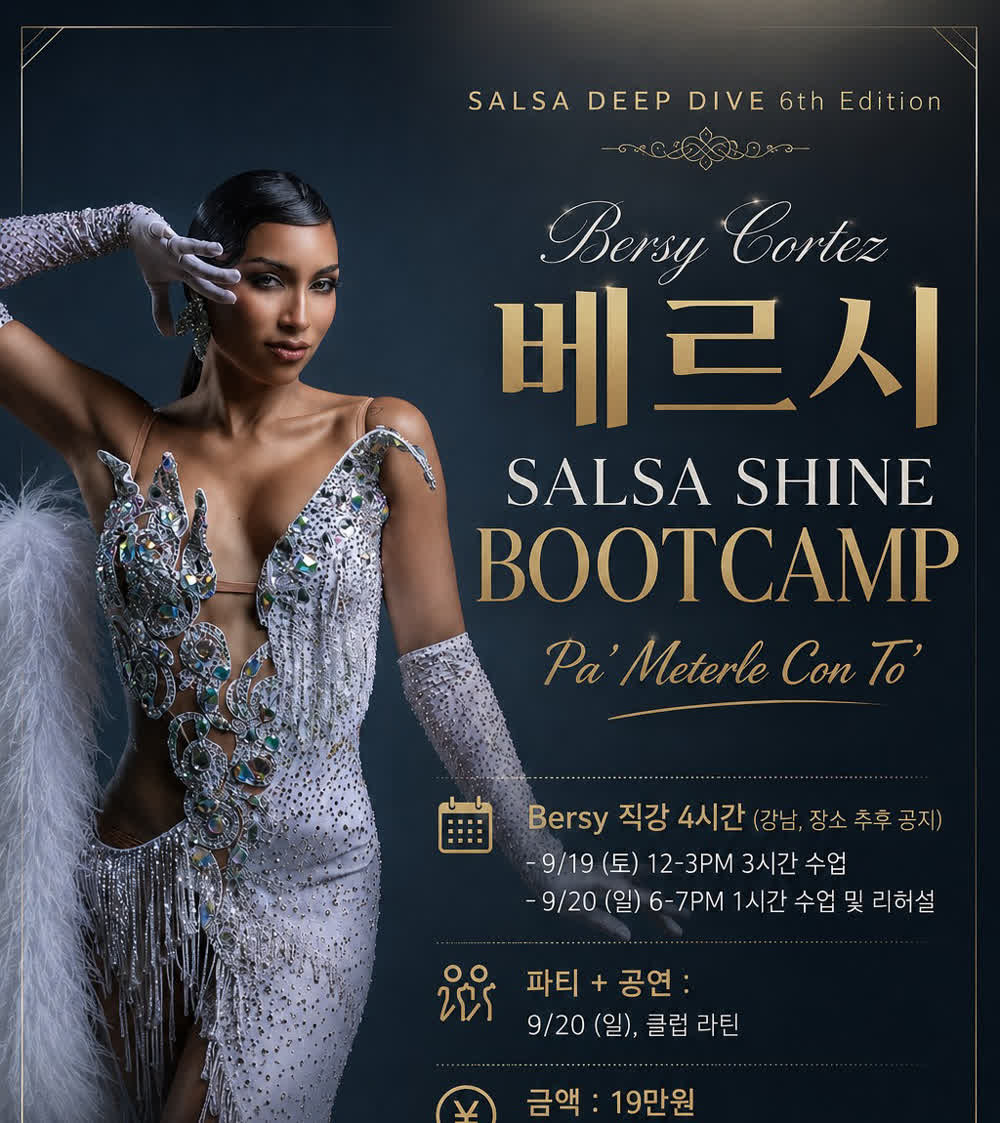
Schedule
Four hours with Bersy, then a stage
You learn the choreography from Bersy and perform it on the final night. The choreo video comes in advance, so all four hours go into refining it.

Passes
Places are confirmed in order of payment. Transfers are possible; cancellations are not.