CHOApedia — 꿀초아 TV Latin ArchiveMy Honey Jar KOEN
Salsa Viva by SuimKorea Tour 2026
La Maestra de las Maestras is Back!

ALIENRAMÍREZ

24× WORLD CHAMPIONBayamo, Cuba → USA → Seoul
Who is Alien?

A dancer and teacher from Bayamo, Cuba, now based in the US (LA and Miami). Trained in ballet, contemporary and Afro-Cuban dance, she has won 24 world titles. This tour calls her la maestra de las maestras, the teacher of teachers.

4
began dancing
19
to the USA
2004
first title
24×
world champion
“Guajiro” Taiwan Salsa Carnival 2019
Until her first session in Seoul · 11.12 THU 20:00
--
Days
--
Hours
--
Minutes
--
Seconds
A Dancer’s Dancer

The dancer dancers admire

Son Nari on Alien

She can dance with anyone. She has more tools than anyone (she can truly dance every style), and yet her own colour is unmistakable. And last of all, a humanity that treasures people.

As a dancer, and as a person, impossible not to admire. Alien.

Organizer Suim on Alien

Built on fierce energy, an original style and solid technique, she has made a dance all her own, and she puts fundamentals, body control and an understanding of music first.

Her workshops, perhaps surprisingly, focus on fundamentals rather than special or complicated moves. Yet the same basic movement reaches a strikingly different level depending on how you use it and connect it.

For me, the chance to experience exactly that difference is the greatest value of her training.

Suim
SALSA VIVA by Suim

Beyond simply learning to dance, Salsa Viva creates experiences where you understand your own movement and grow.

In Her Words

Alien Ramirez: The Origins of Salsa

Salsa’s roots and how to learn it, in her own words

Three interviews, twelve years apart

How salsa came to be

01
Start
From Africa to Cuba

Enslaved Africans brought their rhythms and ways of moving. Tapping two sticks on the ships bound for Cuba became the clave, the base instrument of salsa, she explains.

Salsa, according to Alien

01
2:32 — 5:21

Whose dance is salsa?

To the old argument over which country salsa belongs to, she doesn’t pick one. Most of the elements came from Cuba, she says, but New York added jazz instruments to make today’s salsa.

Cuba’s share, as she sees it4:29 open in interview
80%Cuba
20%Other countries

“I cannot say it is 100% mine. It’s like a baby — even if the baby carries more of my genes than my husband’s, it’s a collaboration between two people.”

Hear it at 5:00
More · 4
  • 2:35Many New York dancers and musicians use “salsa” only to mean the sauce
  • 3:39When rhythms mix, like bolero inside a bachata, people call that salsa too
  • 4:40New York made salsa popular and added a few jazz instruments
  • 4:51What makes salsa sound like salsa today: winds such as trumpet and trombone
02
5:21 — 12:55

The countries that made salsa

  • Cuba, Puerto Rico, the Dominican Republic, Venezuela, Colombia and New York all took part in making salsa
  • Salsa holds what came from Africa and what came from Europe; it’s not about skin colour
  • Most of that mixing had already happened in Cuba before it reached New York
What each place added
WhereWhat they added
CubaMost rhythms and dance elements, son, the mixing before New York
Dominican RepublicThe jazz elements Johnny Pacheco added
Puerto RicoRomantic salsa with poetic, bolero-like lyrics
New YorkPopularity, jazz winds, trombone, timbal
VenezuelaFirst to call it “salsa” on the radio
ColombiaNamed among the countries that built salsa
Two roots
Africa
  • Rhythm
  • Free body movement
Europe
  • Piano, winds, guitar, bass
  • Close position
  • How partners connect

“Salsa is a fusion of different collaborations from different parts of the world — specifically the Caribbean.”

Hear it at 5:21

“The Afro needs the connection, and the connection of partner work comes more from ballroom. Ballroom needs the spice and the freedom of movement of the Africans. Together they complement each other.”

Hear it at 10:38
More · 4
  • 8:02Even earlier, the word appeared in a Cuban son song
  • 8:41The people making salsa in New York came from Cuba, Puerto Rico and the Dominican Republic
  • 9:12Piano, trumpet, trombone and sax are European orchestra instruments, not African ones
  • 9:58Close position, partners holding each other, comes from European ballroom
03
12:55 — 14:22

The clave, in every salsa

  • Whatever the style, salsa sits on the clave rhythm
  • The clave rhythm is African, but as an instrument it was used in Cuba first, she says
One clave, every salsa13:52 open in interview
CLAVE
CubanNew YorkLAPuerto Rico

“That instrument is the base of any salsa — Cuban salsa, New York salsa, Los Angeles, Puerto Rico.”

Hear it at 13:52
More · 2
  • 13:52Cuban, New York, LA and Puerto Rican salsa all keep to the clave
  • 14:02Puerto Rican dancers dance in clave too
04
14:22 — 15:16

Where did the clave come from?

Asked where the clave comes from, she goes back to the ships that carried Africans to Cuba. Packed in for hours with little air, people pulled sticks, clavijas, from the ship and began tapping African rhythms. Two sticks, she explains, and so the name: clave.

How the clave came about
  1. A ship from Africa to Cuba
  2. Long voyage, little air
  3. The ship’s sticks: clavija
  4. Tapping African rhythms
  5. The name: clave
  6. The base of all salsa

“It was a part of the ships — sticks they call clavija. They took them and started playing the African rhythms, because they were bored for so many hours.”

Hear it at 14:23
05
15:16 — 20:40

How Cuba got so many dances

  • Cuban dance falls into five blocks: ballroom, country, folklore, popular, traditional
  • From 1920 to 1960, casino shows in Cuban hotels kept producing new dance styles
  • That’s why Cuba was called the island of rhythm then
Five blocks of Cuban dance18:28 open in interview
Ballroom
  • From the European contradanza
  • The bolero family
Country
  • African and ballroom mixed
  • Different in each of 13 provinces
Folklore
  • Rumba (three styles)
Popular
  • Dances in fashion for a time
  • Some disappeared
Traditional
  • Dances that remain today

“If I am a client and every time I go to see the show it’s the same show, I don’t want to come back.”

Hear it at 19:41
More · 2
  • 16:39Cuban ballroom dances trace back to the French contradanza and an English dance
  • 17:34Rumba, a folkloric dance, has three styles
06
20:40 — 24:35

Why Cuban salsa isn’t just one style

Cuban salsa can’t be pinned to one style, she says, because some mix in more son, some more Afro, some the elegance of flamenco, some ballroom lines. So a professional raised in Cuba comes to the stage with all of it: footwork, rumba, body movement, tricks.

  • Even salsa danced on a line started in Cuban casino shows, not in New York
What salsa took from each root21:57 open in interview
RootWhat salsa took
BallroomFormations, holds
RumbaMoving body parts separately, footwork
FlamencoFootwork, contractions, attitude
AfroBounce, breathing
ContradanzaRueda de casino formations
What a Cuban professional has22:46 open in interview
Men
  • Lines
  • Rumba
  • Body movement
  • Fast footwork
  • Tricks
Women
  • Fast footwork
  • Body movement
  • Attitude
  • Flexibility
  • Elongation

“When you see Cuban dancers, if they’re professional, they do a beautiful art — because they’re complete.”

Hear it at 22:21
More · 1
  • 21:45The circle formations of rueda de casino come from contradanza
07
24:35 — 26:36

Cuba inside New York mambo

  • Each time Cuban dance spread, it changed a little to fit its new home
  • Early New York mambo was elegant like ballroom; the Afro-Cuban side came later
  • Mixing many styles in a two-minute routine is what the casino shows already did

“It’s not new. It’s been done already — and I want people to understand this.”

Hear it at 25:34
More · 3
  • 24:59Mambo today has lines, fast footwork, body movement and Afro
  • 25:39Tricks later used in hustle were done first by circus-trained Cuban salsa dancers, she says
  • 25:52Some moves credited to New York have earlier Cuban footage, she says
08
26:36 — 28:09

From son to salsa

  • Son is the pillar; salsa is the fusion of the dances that came after it
  • Each of Cuba’s 13 provinces has its own country dance, so there is still much to learn
From son to salsa26:45 open in interview
  1. SonThe pillar
  2. Mambo
  3. Cha cha cha
  4. Pachanga
  5. SalsaAll of these combined

“It means it’s a lot to learn, a lot to understand.”

Hear it at 27:30
More · 2
  • 27:13Dances that were briefly in fashion survive today as traditional dances
  • 27:34One kind of son comes from her own province
09
28:09 — 34:19

What do Cubans call it?

  • In Cuba people say salsa, and also casino
  • “Casino” alone sounds like a gambling hall; “salsa casino” is clearer
  • Fixing Cuban salsa to one way makes anyone who dances differently look wrong
Names for Cuban-style salsa32:12 open in interview
NameNote
salsa Cuban styleCuban-style salsa
salsa casinoThe name she recommends
casinoPartner dancing; easily confused with gambling
salsa cubanaSame as salsa casino

“When you put a stigma or a title, it’s like you have to stick with it — if you do something else, you’re wrong. No. You’re free.”

Hear it at 31:38
More · 2
  • 30:52Cuban social dancing can go back and forth like New York or LA, then turn in a circle
  • 31:55Ballroom dancers go to Cuba to learn too
10
34:19 — 38:01

How US salsa classes differ

  • Her first US classes taught counts and patterns with no word about the music
  • The upside: it lets you break things down for people new to the rhythm
  • Classes that say “guys, just do this and she turns by herself” produce men who can’t lead
Count-first teaching34:49 open in interview
Good
  • Breaks it down for people new to the rhythm
Missing
  • No connection to the music
  • Counting over feeling
  • He stands still, she does all the work

“For years the guys look like a stick and the ladies are the ones doing all the job. For performance it works. For social? No.”

Hear it at 36:59
More · 5
  • 34:20She has danced LA and New York style for over 20 years
  • 35:26Gymnastics and ballet made tricks and turns come easily
  • 36:13Bringing out the feel of the music matters in every style, not just Cuban
  • 37:11An experienced follower fills in what the leader misses; a beginner can’t
  • 37:22With a beginner, lead clearly, one step at a time
11
38:01 — 39:12

Leaders: how to check your own skill

This is how a leader can check his own skill. Not by how flashy his moves are, but by dancing with followers of every level, beginner to pro, and seeing whether every dance feels easy. A strong follower fills in what the leader misses, so dancing only with good dancers won’t tell you whether your lead works.

  • If even a beginner follower feels at ease with you, your lead is working
  • Switching styles is another test: if New York works but you stiffen up in Cuban, you haven’t yet learned to change how you use your body
Dance with these four followers38:00 open in interview
  1. Beginner
  2. Intermediate
  3. Advanced
  4. ProfessionalAt ease with all four: your lead works
When a NY-style leader dances Cuban38:32 open in interview
Change
  • Where the energy goes
  • A diagonal body
  • More elongation
  • Pivot on the foot
  • Show direction with the body

“How do you test your skill as a good leader? When you can have a decent dance with a beginner, an intermediate, an advanced or a professional — then your technique is impeccable.”

Hear it at 38:00
More · 4
  • 38:26Some dance New York style well but struggle with Cuban
  • 38:36Cuban asks for a more diagonal body, more elongation, more pivots
  • 38:41Without pivoting on the foot, the body can’t follow and looks robotic
  • 38:49The leader shows the direction with the body
12
39:12 — 46:53

The basics you can’t skip

Asked for her non-negotiables, she counts them out: marching in place, weight shifts, front, back and diagonals, right and left turns. That is what the November 15 training is about.

  • Your own style grows out of the basics, not out of breaking the rules
  • How you do it matters more than how much you do
Alien’s salsa basics mechanism, a grand maestra classHoneyChoa TV · class
Only Basic: the maestra’s basicsHoneyChoa TV
The non-negotiables39:28 open in interview
Checklist
  • Marching in place
  • Weight shift front and back
  • Weight shift side to side
  • Diagonal front, diagonal back
  • Cross in front, cross behind
  • Right turn, left turn
What the leader’s body says39:45 open in interview
LeaderFollower
Shifts backGoes back
Comes forwardComes forward
Goes sidewaysGoes sideways
Twists the bodyGoes diagonal
Over-rotatesCrosses deeper

“Some people say, “Alien, your name goes with your stuff — you’re from another planet.” No, I’m not from another planet. I’m using basics.”

Hear it at 40:20

“I’m the result of what you give me.”

Hear it at 42:07
More · 7
  • 40:44People break the rules to look original and get injured
  • 41:24If the leader gives half a signal, the follower gives half a response
  • 42:49To women: help a man fix his mistakes instead of crushing his confidence
  • 43:13Some teachers hold back the answer to keep students longer, she says
  • 44:00She gives all the fundamentals in one hour; the more she gives, the more comes back
  • 44:36Safety in dance means not getting hurt, not only sexual safety
  • 45:51A great ballet dancer asked to be taught like a total beginner, and learned fast because of it
13Learning it the right way46:53 — 1:16:37 ↗
a
46:53 — 48:26

No dance is easy

Even bachata, picked up because it looks easy, turns out to need breathing, body waves and an ear for the instruments. The moment you want to do it right, every dance takes a process, she says.

  • You don’t have to be perfect first, but taking lessons before the party is your responsibility to your partner
  • Dancing is connecting, not showing off, and connecting starts with listening to the music

“Nothing is easy when you want to do it right.”

Hear it at 47:22
More · 3
  • 47:02People say bachata is easier than salsa
  • 47:08Bachata has its own breathing, body waves, instruments to follow and partner work
  • 48:14Even without the lyrics, listen for the mood and energy of the music
b
48:26 — 54:06

Losing balance? Check your elbows

  • Losing balance when going from solo to partner work is usually about the elbows
  • Even in a back-and-forth style, turn the torso like in Cuban so you don’t hit your partner
Why balance goes52:36 open in interview
90%
Elbows pulled behind the back
Where the elbows go
WhenElbowsResult
ShinesOut, back engagedFaster feet
Partner sombreroLevel with the shoulders, from the torsoArms only feels rough
Shimmy, hand stylingDiagonally in frontLess effort
AvoidBehind the backLost center, collapsed frame
AvoidLocked straightStiff body, easy to get hurt

“Most of the time, when a person feels they’re getting away from their center or losing balance, it’s because their elbows are in the wrong position.”

Hear it at 52:26
More · 5
  • 49:26In the Cuban moves sombrero (hat) and hanger, elbows line up with the shoulders and the torso does the work
  • 50:10New York and LA dancers often hit her in Cuban salsa because they don’t turn the torso
  • 51:14Broken nails and pulled hair happen
  • 51:29In solo shines, elbows out engages the back and makes the feet faster
  • 53:43If the elbows drift sideways during hand styling, the weight follows and balance and rhythm go
c
54:06 — 56:56

Telling stories with your hands

  • In rumba and Afro you don’t hold hands; you talk to your partner with the torso and hands
  • In orisha dances every gesture shows that orisha’s story
  • Keeping the arms close to the body matters in Afro too, not only in ballroom
Orisha gestures54:24 open in interview
GestureMeaning
Pointing at braceletsAn orisha who loves gold bracelets
Holding the crownAn orisha holding her crown as she dances
Rolling a long skirtThe waves of the sea
Booted feetAn orisha in boots
Holding a stickOpening the road for the people
Three heights of movement55:40 open in interview
  1. SkyHigh
  2. PeopleMiddle
  3. EarthLow

“It’s like telling your story. Your hands actually give you a picture of what’s going on.”

Hear it at 55:05
More · 4
  • 54:17Cubans use their hands so much because the hands tell the story
  • 55:40Afro-Cuban movement shows three forces by height: sky, people, earth
  • 56:00The sounds of the music were made to reach the gods and the forces of nature
  • 56:28Over-straighten the elbow in Shango moves and you can get hurt
d
56:56 — 59:47

Not in the blood — in the body

  • Some Caribbean dancers skip classes because “it’s in our blood,” but it has to be in the body
  • Steady practice beats natural passion
  • A Caribbean leader with both rhythm and body communication is a different level
Blood and body
In the blood
  • Thinking classes aren’t needed
In the body
  • Discipline
  • Consistency
  • Technique
Leaders she enjoys dancing with57:19 open in interview
From
  • Russia
  • Kazakhstan
  • Korea
  • Japan
  • China

“My love, you hurt me, because you don’t have technique. You have it in the blood, but you don’t have it in your body.”

Hear it at 57:30

“With discipline and constancy, it beats just the passion.”

Hear it at 58:24
More · 2
  • 57:51Dancing is putting the music into the body
  • 58:12Asian and Russian dancers excel through discipline and consistency
e
59:47 — 1:06:21

Manners on the social floor

  • On the social floor, don’t show off what you learned; match your partner’s level
  • A basic step with real connection is more fun than lots of moves
  • The person matters more than the music, and the community more than her own name
On the social floor
Do
  • Match their level
  • Connect and enjoy
  • Ask politely, walk them back
  • Mind smell and clothes
Don’t
  • Non-stop moves
  • Asking pros for a free show
  • Drinking and side steps only

“For me, with empathy, the person is more important than the music.”

Hear it at 1:04:35

“At the end of the day it’s not about the ego of Alien Ramirez — it’s about the community.”

Hear it at 1:05:15
More · 6
  • 1:01:01Non-stop moves turn a song into a two-minute performance; two hours of that exhausts your partner
  • 1:01:23After festival work, at night, she wants to relax and enjoy
  • 1:01:48Some people ask a pro for a free show on the social floor
  • 1:03:11Like a doctor using jargon with colleagues and plain words at home, adapt to your partner
  • 1:03:52She sometimes goes off time on purpose to follow her partner
  • 1:05:25Manners: how to ask, walking her back, smell, clothes, gum after eating
f
1:06:21 — 1:16:37

On1, on2 and the instruments

  • Each instrument gives a different feel, so the same step looks different depending on which one you follow
  • On2 is popular now because it leaves room to breathe
  • More instruments on one doesn’t make salsa “on one”; in the end you follow the music
Instruments that drive on2 and on11:14:12 open in interview
On2
  • Clave 2-3
  • Timbal
  • Bass
  • Drum, conga
  • Piano in the montuno
  • Winds in the montuno chorus
On1
  • Guitar
  • Piano
  • Trumpet
  • Trombone
  • Sax
  • Flute
  • Maracas
Clave 2-31:10:18 open in interview
Clave●●●●●
Two hits, a pause, three hits; that pause is where the on2 feeling comes from
What each city dances to1:12:16 open in interview
WhereFollows
New YorkDrum, conga
LAThe singer’s voice, the piano melody

“Because there are more instruments on one, salsa is on one? Alien has more of daddy’s genes — so mommy didn’t work on it? Both of them collaborated for me to be born.”

Hear it at 1:15:00

“At the end of the day, our GPS is the music.”

Hear it at 1:16:24
More · 5
  • 1:07:40Ten routines that stay at full excitement start to finish wear an audience out
  • 1:08:18On2 routines now combine Cuban, New York Palladium, NY ballroom, fast LA turns and tango
  • 1:09:06Competitions are won by whoever executes the most styles, pachanga, mambo, son, afro, rumba, cumbia, bomba, the right way
  • 1:10:01The bass stresses beats 2, 4, 6, 8
  • 1:15:11Her mother is darker, with native Cuban roots; her father is white, of Spanish descent
Programs

Two ways in

Program 1Date confirmed
PROFESSIONAL DANCERS TRAINING
Three hours, all in
Date
Sun, Nov 15
Time
14:30 — 17:30
Venue
Gangturn · Gangnam
TechniqueMusical interpretationExpressionPerformance

Not just for professionals: improvisers, performers, teachers and competitors are all welcome. Beyond learning new moves, a time to discover how to grow your own dancing.

Her non-negotiable basics ↑
Program 2Ends on stage Nov 14
AFRO-CUBAN BOOTCAMP
Orisha movement, one piece, one stage

Training in the movement and expression of the orishas, set to Afro-Cuban music. Alien Ramirez, Korean instructors and participants build one piece together, and take it to the stage.

Sessions with Alien
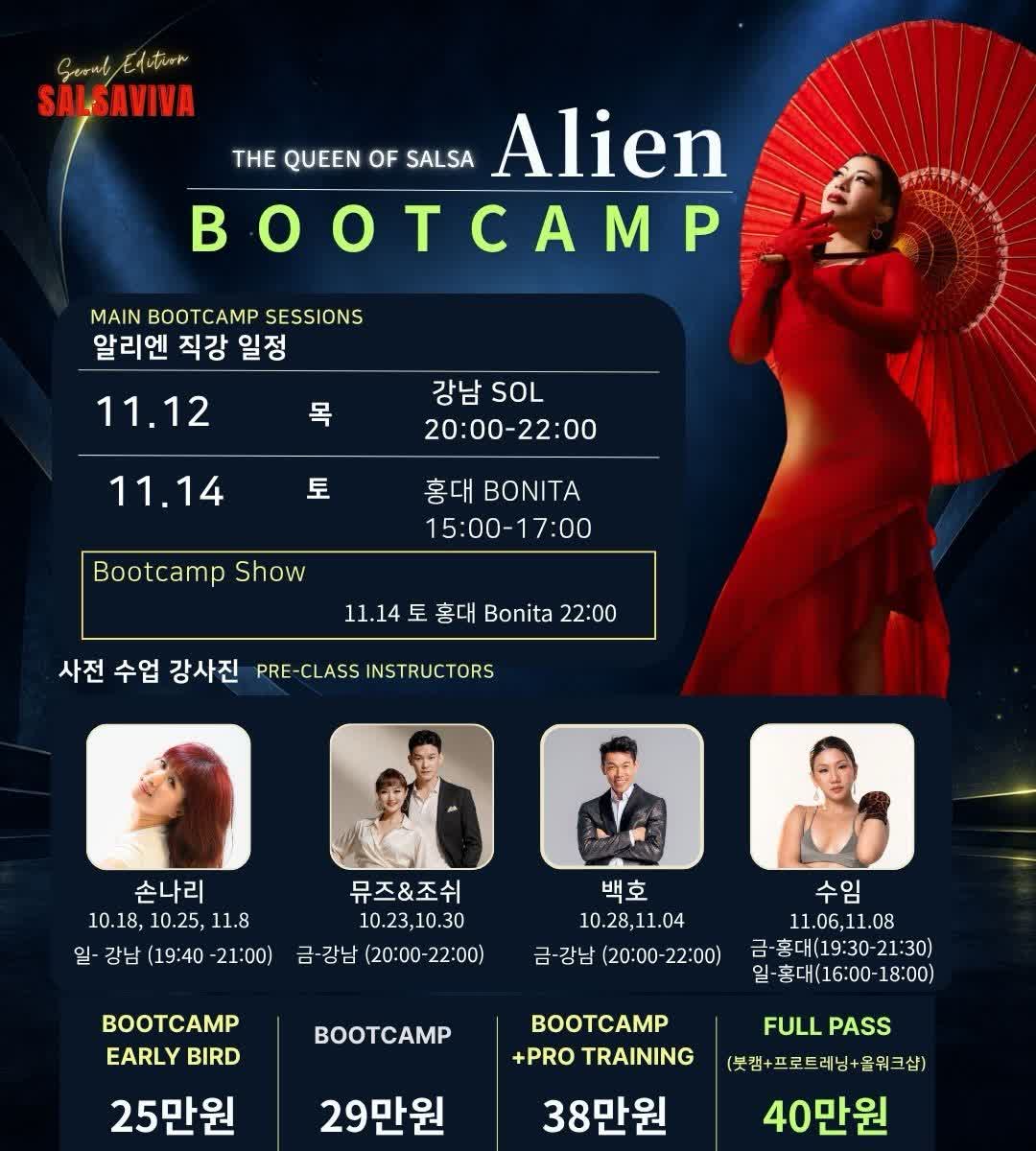
11.12 THUGangnam SOL20:00 — 22:00
11.14 SATHongdae BONITA15:00 — 17:00
11.14 SATBootcamp Show · Hongdae BONITA22:00
Pre-class instructors
Son Nari10.18 · 10.25 · 11.83 Sundays, Gangnam 19:40–21:00
Muse & Josh10.23 · 10.302 Fridays, Gangnam 20:00–22:00
Baekho10.28 · 11.42 Wednesdays, Gangnam 20:00–22:00
Suim11.6 · 11.8Fri Hongdae 19:30–21:30, Sun Hongdae 16:00–18:00
Pre-class venues are announced to participants.
What she says about hands and orishas ↑
Passes
Pro Dancers Training (3h)150,000KRW
Boot camp, early bird250,000KRW
Boot camp290,000KRW
Boot camp + Pro Training380,000KRW
Full pass (boot camp + training + all workshops + 4-day socials)400,000KRW
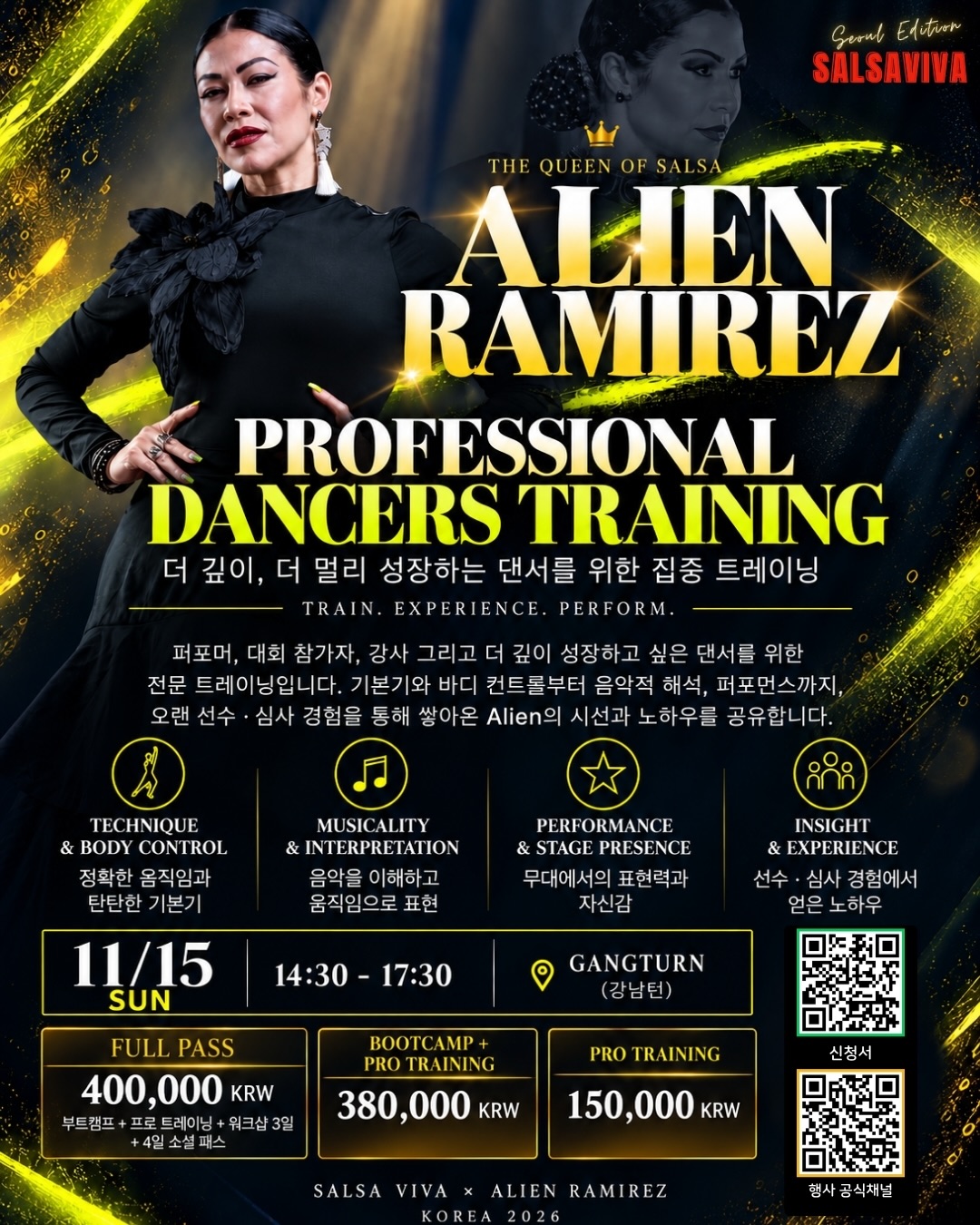
Professional Dancers Training · official poster
Afro-Cuban Bootcamp · schedule & instructors
Professional Dancers Training · official poster
Heart Board

Excited for the tour?

Tap the class you’re hyped for and a heart pops on · no login · yours sparkle12 hearts and counting
Voices

Leave a line