 My Honey Jar

Daniel y Alma
다니엘 알마

 ▶short interview
[CHOA's Short-terview 18] Gatz & Honey personally introduce 'Daniel & Alma' — a month of Spanish bachata study abroad without leaving Korea 💕
Meet the person before the class. One shorterview and their dancing hits different.

Latest first5 videos

(Bachata) "Let's play with the music" — where musicality starts, right in your basic: 6 basic syncopations by Daniel Alma
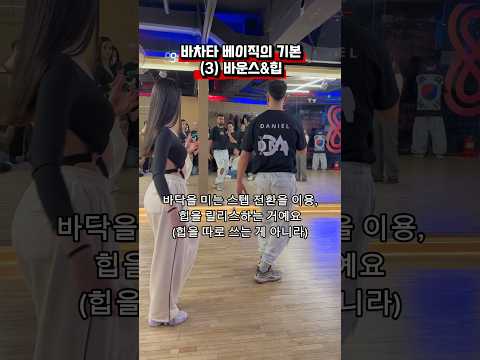
(Bachata) Dominican mini sequence wrap-up built from nothing but basics — Daniel & Alma LATIN workshop

(Bachata) Basic Dominican steps our socials need ASAP! Daniel & Alma Dominican workshop @ LATIN

(Bachata) Prepare Before — the prep-move details that show just how hard leads work — Daniel Alma workshop by Gatz Honey

(Bachata) Rotations using tilt and DJ turns ✨ lead with your body like a Spanish guy — Daniel Alma workshop by Gatsu Honey




 Collecting these slowly, one at a timeThey get better every rewatch

(Bachata) Fully acclimated to Korea! Daniel & Alma hit their stride — a taste of the workshop demo

(Bachata) All-man Daniel meets silky-lined Alma — full Beauty & the Beast chemistry! The realest social demo from Daniel & Alma, by Gatz & Honey

(Bachata) Daniel & Alma, the pair sending you to Spain in 2026 — their very first demo in Korea ✨ by Bassion Gatz & Honey

“When you go into the rotisserie, remember you're not using your waist. I'm just using the extension of my chest.”
On the rotisserie turn — the movement comes from extending the chest line, not from the waist.
Watch that moment →“If you push with the arm, it gets heavy. What we want is to do it with the shoulder blade. Down, and in.”
Demonstrating the difference between pushing with the arm and activating the shoulder blade
Watch that moment →“The box — your upper body — basically wants to rise up toward the ceiling, but the weight doesn't change.”
In the rotisserie turn, the upper body should feel like it's lifting while the center of gravity stays put.
Watch that moment →“On the tilt, I'm working to lift my upper body up. So I'm riding an upward trend, not a downward one.”
The detail that a tilt should feel like rising, not like dropping.
Watch that moment →“Watch closely — I'm not moving like some big cobra. It looks more like I'm reeling in a fishing line and opening my chest.”
Describing the texture of the chest-opening movement in the rotisserie turn, in contrast to a cobra-like move.
Watch that moment →“Don't let go of the arm — it's right here. What's the next move? Open, touch. So what do you need? Control, position.”
Leading with questions, drilling them to prep the next movement ahead of every single step
Watch that moment →“Always be thinking about what the next move is.”
The core message running through the whole workshop — a repeated push to think one movement ahead, every moment
Watch that moment →“If you're gonna make a circle with your hand, you have to prep it ahead of time.”
Explaining that you need to set up the prep position before the hand movement (circle)
Watch that moment →“This arm has to be right here. Otherwise the figure is over.”
Explaining how crucial the arm connection and tension are before entering a figure
Watch that moment →“You can't just turn without a contraction. The order matters. First you close your chest for the contraction, and then you turn.”
Correcting the order the body moves in on the turn that goes from the tilt into the DJ turn
Watch that moment →“That's how you release the hip, make the bounce, and get to use your hips — whether it's traditional bachata or sensual style.”
Explaining how the toe-to-heel step and the bounce connect to hip movement
Watch that moment →“Toe to heel — you shift your weight and push the floor away. Toe to heel, push the floor.”
Explaining the footwork of the bachata basic step (toe-to-heel)
Watch that moment →“If you do the contraction first, she can turn so much more easily.”
Making the case for the contraction-then-turn order from the follower's comfort
Watch that moment →“Think first.”
The closing line, dropped right after walking through the open–contraction–release sequence
Watch that moment →“If the next move is an open, your hand has to prep for it first.”
A repetition drill on setting the hand prep before the open
Watch that moment →“This isn't done with the shoulders, it's done with the chest. Keep your neck where it is.”
Repeating that the turn comes from the chest, not the shoulders
Watch that moment →“On the way up you add power — you push the power out into your hands.”
Explaining that on the lift, the force has to travel all the way out to the fingertips
Watch that moment →“When I feel him inviting me in, that's when I start turning my chest.”
The follower's side — how she reads the leader's signal and answers it with a chest rotation
Watch that moment →“When you stretch, don't lock your knees.”
A caution about the stretch movement while practicing the bounce
Watch that moment →“In an 8-count, or in 4+4, you're not just riding 1, 2, 3, 4 — you can play with the 'and' counts in between.”
Introducing basic syncopation and explaining the idea of using the off-beat ('and' counts) instead of just the downbeats
Watch that moment →“If you do it like this, your partner just spins off and the connection is gone.”
Demonstrating how a wrong lead breaks the connection
Watch that moment →“Fingers pointing down, and you finish at the elbow, not the shoulder.”
Fine-tuning exactly where the hand and elbow go in the tilt
Watch that moment →“If my shoulder blades are activated but my arms are released, then when my partner tries to give me tension, I can return it automatically without even trying.”
Explaining how connection is exchanged with a partner through shoulder-blade tension alone while the arms stay released
Watch that moment →“I'm not pushing. I just have tension in the shoulder blade, and that sends the tension back automatically.”
Restating the difference between pushing with the arm and using shoulder-blade tension
Watch that moment →A word about Daniel y Alma? No login.