 My Honey Jar
  ← Back to Explore
 FULL 16:9
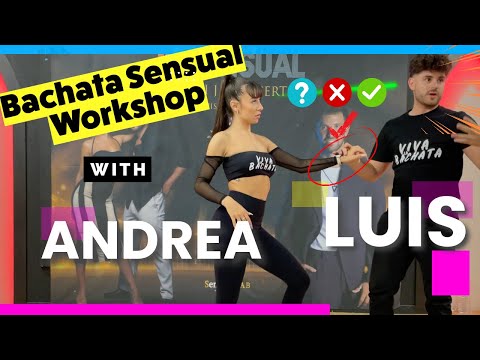
Luis y Andrea Bachata Workshop - Body Lead & Resistance
 10
10

Lines worth chewing on — tap to jump to the moment.

“We have to control ourselves. Because we need to do sharp turns and control our syncopations.”
CONTEXTExplaining why footwork comes before couple combinations
“Controlling myself, controlling my movement — that's what you have to train. Solo training is a must.”
Explaining why every class starts with footwork, stressing the importance of solo training
“There are two connection points. One is where the center of my hips meets the guy's hips, and the second is the upper body, where we connect through breath.”
CONTEXTExplaining the body's two connection points in the basic position
“There are three basic positions: closed position, where body meets body; medium position, holding just one hand; and open position, for combinations and turns.”
Explaining the three basic positions of bachata sensual (closed / medium / open)
“Every position has its own movements. Leaders, when you're not sure what to do, use these three — closed, middle, open. Each one has a job.”
Stressing that the three positions each serve a different purpose, with a practical tip for leaders
“My leading is great. But where's my dancing?”
CONTEXTCalling out a long-standing problem in bachata sensual — leaders who only lead and never actually dance
“Lead with your body! I want to lead with my body.”
First introducing the core principle of body lead
“Always stay at the same level as your follower. She goes down, I go down with her. She comes up, I come up. Never stay on a different level.”
The second rule of body lead — why you always have to stay on the same level as your partner
“Don't finish the movement — wait here, then start the next one. Don't come back to your original position.”
CONTEXTAnother rule of body lead — how not to break the flow between movements
“The mirror drill takes away the physical connection — the hand hold — so the leader is forced to lead with nothing but his own body. It's training for the body lead of a leader who actually dances.”
CONTEXTIntroducing a drill led purely through visual connection (mirroring), and explaining what it's for
“When you practice a movement, don't make it small. Push it all the way to the limit of your body.”
Advice from solo body training — take your range of motion as far as it goes
“Really feel every point of the movement, use every muscle, feel the tension in each part. Always go to the limit and come back.”
Explaining how to practice movement using the whole body
“Your elbow should always sit at the line of the woman's chest. Never lift it up — stay relaxed.”
Explaining the basic principle of elbow frame
“Bend your elbow, so the energy coming from your hand travels to the elbow, from the elbow to the shoulder, from the shoulder into your upper body.”
CONTEXTExplaining how energy travels through the elbow
“Breathe in as the elbow goes up, breathe out as it comes down. The elbow is connected to your lungs.”
Explaining the connection between the elbow and your breathing
“If you're not generating energy through your breath, up and down, you'll never get supple movement. Just breathe.”
Explaining the relationship between movement and breath, framing breath as the key to fluid movement
“I'm always flying. It's not mechanical like this.”
CONTEXTComparing organic movement, made with up-and-down energy through the breath, to a feeling of flight
“The core is where the upper body and lower body connect, and it's where the connection between the man and the woman happens. You have to hold that core as much as you can.”
CONTEXTOn the core — the hardest part of the wave
“Pushing your core forward until the very last moment as you go back — that's the moment of resistance.”
CONTEXTExplaining exactly how to create resistance in the wave
“We always go fast fast fast. We know the movement, but we do it way too fast.”
CONTEXTCalling out how students focus on speed and never feel the resistance
“Dance like you're inside a honey jar — keep the resistance in your muscles high.”
CONTEXTExplaining the concept of resistance, using a metaphor for the feel of 'honey' resistance
“Honey, water, air — three kinds of resistance, and they let you express the same movement in totally different ways. Even within one combination, mixing up the resistance opens up all kinds of expression.”
Introducing the three resistances used in bachata (honey, water, air) and how to give the same move a different texture
“Learning body lead means learning two things at once: the movement you can see, and the invisible force going the opposite way. It's not just where and how you move — creating that opposing energy is the key.”
Explaining the physics of resistance and stressing the importance of the counter-directional force
“If you don't give me this energy, I can't give you any changes. If we just keep dancing mechanically with the same resistance, it gets boring.”
CONTEXTFeedback after the social — when a partner doesn't send energy, the lead ends up running on autopilot
“Your dancing is fun! But from my experience, try to feel this energy more.”
CONTEXTEncouraging students during social feedback to feel the energy more
“The leading is really good, the following is really good. But try to listen to the music, and when you hear it, try to feel this energy.”
CONTEXTFinal feedback after the workshop social — the patterns are solid, now feel the music and the energy



How was this one? Leave a line — no login.

Pulled from the same drawer — keep watching.
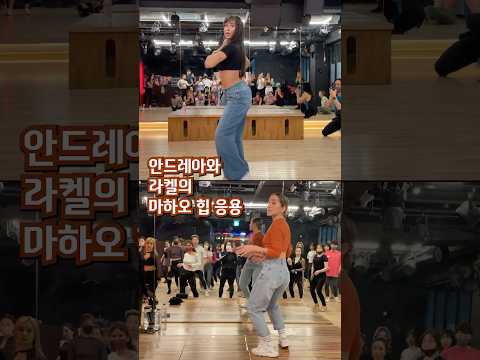
(Bachata) Andrea & Raquel Break Down the Majao Basic — Principles & Variations
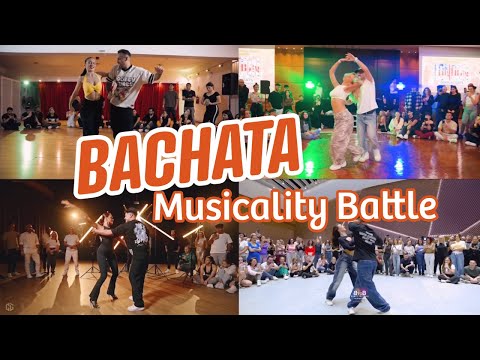
(Bachata) Musicality battle — who's your one pick? Clau & Ross vs Jhero & Migle vs Luis & Andrea vs Cristian & Gabriela | Mamacita
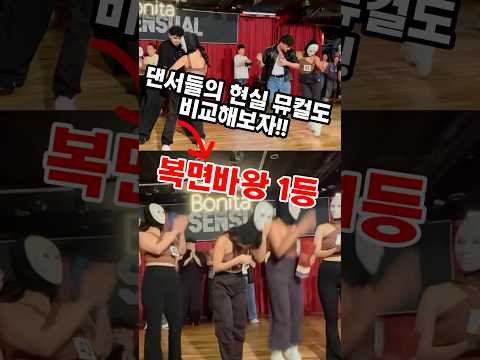
(Bachata) Who's behind the mask in the 1st Masked Bachata King? Luis vs Carlos — plus a real-talk musicality comparison across dancers!! K-Sensual by Wongung & Yoni
