 My Honey Jar
  ← Back to Explore
 SHORTS 9:16
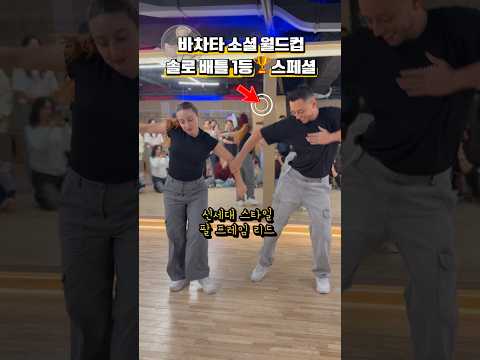
(Bachata) New social tricks you can use tonight~ Install the upgrade patch⚡️ Gatsu & Honey's Lunar New Year class at Latin


Lines worth chewing on — tap to jump to the moment.

“On the up out of the down-down, just let the arm slip out. Ladies, don't pull out first — rest your elbow on there.”
CONTEXTCues for the lead and follow on what each does with the arm at the start of the move
“Your leg is coming up, so the tension in your neck and arms has to be gone.”
CONTEXTExplaining the body mechanics of why the follow has to stay relaxed in this move
“You're not pressing down with the arm — go in with the feeling of drawing a big wide circle.”
CONTEXTA cue to move along a circular path instead of pressing with force in a particular arm movement
“If your shoulders go flat and level, it's hard for her to read what's coming next. Giving that counter-action feel is what matters.”
CONTEXTExplaining how asymmetrical shoulder counter-action in the lead makes the follow's job easier to read
“On a turn, it's not about lifting your arm — the shoulder opposite the direction you want to turn has to go in first, that's what lets her read the next move.”
CONTEXTExplaining why you use the counter-action of the shoulder instead of the arm when leading a turn
“You have to lead her to travel far — that's what makes the move easier for her to understand.”
CONTEXTExplaining that a clear sense of distance in the lead helps the follow recognize what's next
“The point isn't to get there, it's to open her up and make space for the turn. The hand itself isn't the point — turning her is the point.”
CONTEXTExplaining that you shouldn't fixate on where your hand ends up, but on the purpose: creating your partner's turn
“I should be riding on top of the guy's hand — and the lower hand has to stay down there the whole time so she can ride on it.”
CONTEXTExplaining the weight-transfer principle of the follow using the lead's hand as support
“You're not going back, you're going up. He brings you down, so you use that upbound — the back foot swings out and then you come back up.”
CONTEXTStressing that the direction of the movement is upward bounce, not backward
“If you keep the feeling that you've pressed the bounce down, then press again as the body lifts, you get a much smoother round.”
CONTEXTExplaining the timing of bounce and pressure that makes the movement smooth
How was this one? Leave a line — no login.

Pulled from the same drawer — keep watching.